Peace talks with Putin mean surrender, not safety. Russia seeks Ukraine’s erasure, not compromise. Every “white flag” demand ignores the genocide already unfolding. Supporting Ukraine isn’t optional—it’s survival for democracy itself. Only Russian defeat can end the killing and open a path toward a better, freer Russia.
Tag: peace
#301: Does Putin Love Russia?
Putin does not love Russia—he exploits it. True love of country means caring for its people, not sacrificing them to imperial delusions. His wars, repression, and destruction expose hatred disguised as patriotism. Ukraine’s survival demands Russia’s defeat—and only then can Russians reclaim their nation from his toxic legacy.
#298: Ukraine Can and Will Win. Why and How?
Ukraine's victory over Russia appears increasingly inevitable despite widespread pessimism. Putin's strategic miscalculations—failing to manipulate Trump, underestimating European resolve, and stalling military offensives—reveal fundamental weaknesses. Ukraine's technological innovation, democratic resilience, and forward-looking strategy contrast sharply with Russia's backward-looking imperial nostalgia. Historical precedent confirms: ideologues lose to pragmatists in prolonged conflicts.
#296: Putin’s Mistakes
Putin’s hubris has led him to grave miscalculations, underestimating both the resilience of the West and the consequences of his authoritarian reign. His dismissal of opposition and reliance on natural resources over innovation have stagnated Russia, proving that true strength lies in the system, not the ruler. The war's toll is ultimately self-defeating.
#295: Trump Met Putin – The Aftermath
In a tense meeting overshadowed by desperation, Trump and Putin's Alaska rendezvous was anything but triumphant. Trump, visibly uneasy, faced a seemingly manipulative Putin who twisted narratives of Ukraine's existence. This was a failed spectacle, revealing Putin's weakness rather than strength, leaving the world questioning any potential outcomes. A mere façade of power crumbled.
#292: Trump Meets Putin: What to Expect?
Trump’s forthcoming engagement with Putin is portrayed as a misguided exercise in self-importance. Ukraine’s resolve remains unshaken, while Russia faces mounting decline. Proposals involving territorial concessions are condemned as perilous appeasement. Embracing Kremlin narratives, the argument suggests, undermines democratic principles and rewards aggression over resilience and strategic clarity.
#291: Whenever You Negotiate, You Need to Know the Details.
Putin’s ambitions extend beyond mere territory; they're about control and global influence, cloaked in a facade of negotiation. Trump’s simplistic business mindset risks overlooking the complexities of the Russia-Ukraine conflict, treating it like a mere transaction. Ukraine’s struggle is not just for land but for justice and existence against corruption and manipulation.
#285: Ukraine Is Not Perfect,But Still Deserves Our Support
Ukraine’s imperfections don’t negate its right to resist invasion. The argument rejects moral absolutism and urges support for Ukraine despite its flaws. Equating criticism with abandonment is dangerous. In the face of authoritarian aggression, solidarity must be grounded not in purity, but in principle, realism, and democratic conviction.
#282: Enough Already. Hamas is Sufficiently Weakened, and People Need a Future
#278: We Hate Everyone: Against the Politics of Vitriol
We’ve become a "we" that thrives on disdain for differing views, a reflection of tribal instincts gone wild. Cancel culture fosters this toxicity, pushing us into rigid bubbles. Instead of embracing complexity, we dismiss and hate. It's crucial to seek understanding and compassion, dismantling these walls, rejecting hatred for a more united future.
#273: Peace Needs Justice: It Matters How to Make Peace in Ukraine
Peace in Ukraine cannot be achieved through compromise alone; it must be grounded in justice. Any settlement that rewards aggression risks undermining international law and emboldening future violations. The path to lasting peace requires accountability for war crimes, recognition of Ukraine’s sovereignty, and a rejection of false moral equivalence between aggressor and victim.
#272: Is This All a Brilliant Plan?
The notion that U.S. neutrality could broker peace in Ukraine is critically examined and ultimately dismissed. The analysis argues that Putin’s broader goal is the destabilization of the West, not just control over Ukraine. Attempts to frame erratic U.S. behavior as strategic misdirection are seen as dangerously naive, undermining global trust and empowering authoritarian regimes. The post warns that such tactics risk alienating allies, distorting public perception, and weakening the foundations of democratic governance.
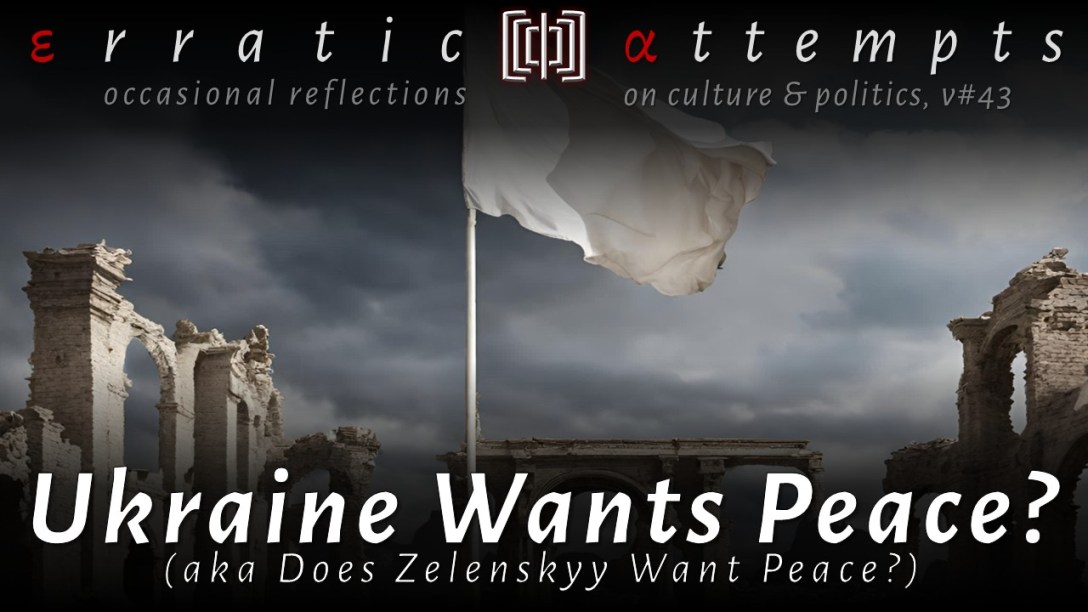
#271: Does Zelenskyy Want Peace?
Claims that Zelenskyy does not want peace ignore the reality that Ukraine is defending itself against ongoing Russian aggression. Peace, as defined by Ukraine, must include justice and the restoration of sovereignty—not capitulation to territorial demands enshrined in Russia’s constitution post-invasion. The post argues that Russia’s continued offensives, occupation tactics, and history of war crimes undermine any trust in its intentions. Calls for immediate ceasefire without accountability risk legitimizing violence and silencing the victim. Real peace, it concludes, must confront imperialism and protect democratic self-determination.
#270: Our Soft Power and Reputation Are at Stake with Ukraine
Soft power is crucial for America; it's the glue that binds allies and amplifies influence. Yet, current strategies under Trump threaten this, making the U.S. appear complicit with a dictator like Putin. Weakening relationships with Ukraine and Europe risks alienating global support for democracy. Stand firm against tyranny; it’s a moral imperative.
#269: Trump’s Toxic Negotiation Style Echoes Putin’s Propaganda
Zelenskyy isn't a dictator, and blaming him for the war is absurd. Trump's bizarre diplomacy embarrasses the U.S., failing to recognize Ukraine's fight for democracy. With real elections unfeasible amid Russian aggression, America must back Ukraine to uphold its values. Stop the nonsense—action is needed before it’s too late.
#268: Peace in Ukraine – Trying to Stay Calm and Carry On
Calls for peace in Ukraine must confront the reality of Russian aggression and the moral implications of compromise. The text argues that equating both sides risks legitimizing violence and undermining justice. True peace requires acknowledging Ukraine’s right to self-defense, rejecting false neutrality, and resisting pressure to normalize occupation and war crimes.
#267: Are the United States Abandoning Europe?
The US, Europe’s historical protector, mustn’t bear the burden alone. With rising threats from Russia and China, European leaders are complacent, neglecting military readiness and partnerships. As democracy hangs in the balance, Europe needs to abandon its reliance on American power and take proactive measures. A wake-up call, indeed.
#265: Ukraine Wants Peace and Russia Must Lose
Claims that Ukraine obstructs peace are dismissed as Russian propaganda. Ukraine seeks peace through sovereignty and justice, while Russia pursues domination and the erasure of Ukrainian identity. The war is framed as a moral struggle: defending democracy against tyranny. True peace requires Russia’s defeat, reparations, and accountability for its leadership.
#264: Freedom from Assad
The fall of Bashar al-Assad is presented as a victory for Syria and humanity, marking the end of a brutal regime responsible for torture, repression, and regional instability. The post links Assad’s defeat to the weakening of Russian and Iranian influence, and highlights Turkey’s role in supporting Syrian liberation. It raises questions about Syria’s future, emphasizing the need for moderation, justice, and democratic governance. The conclusion reflects on Syria’s ancient civilizational legacy and expresses hope for a more peaceful and dignified future for its people.
#263: Don’t Believe Putin’s Lies. He Can (and Must) Be Defeated
Putin’s narrative of inevitable victory is exposed as a strategic lie designed to demoralize opposition and fracture international support for Ukraine. The post argues that Russia can be defeated—militarily, politically, and morally—if the West maintains resolve. It warns against fatalism and urges continued support for Ukraine as essential to defending democracy and deterring authoritarian aggression.
#258: Ukraine Must Win. Understanding Russia’s Imperial Ambitions in Ukraine
Russia’s war against Ukraine is driven by imperial ambition, not security concerns. The analysis traces this aggression to a long-standing denial of Ukrainian identity and sovereignty. It argues that Ukraine must win—not only to preserve its independence, but to halt the spread of authoritarianism and restore credibility to international law. The conflict is framed as a decisive moment in the global struggle between empire and self-determination.
#255: Reflections on Recent Developments in the War Against Ukraine
Russia’s continued assault on Ukraine’s infrastructure and civilian life underscores the need not just for its failure, but for its defeat. Zelenskyy remains Ukraine’s legitimate leader under martial law, while Putin’s regime is marked by electoral fraud and propaganda. The so-called Russian “peace plan” is exposed as a strategy for annexation and repression. Ukraine’s fight is framed as a defense of democracy against tyranny, with broader implications for global stability. The post warns that failure to support Ukraine risks emboldening Russia’s imperial ambitions across Europe and beyond, and calls for stronger sanctions, sustained military aid, and moral clarity in confronting authoritarian aggression.
#252: Some Reflections on Israel, Gaza, and Protests
The post reflects on the Israel-Gaza conflict and the global protests surrounding it, emphasizing the need for moral clarity and historical awareness. It critiques simplistic narratives that equate both sides, arguing that Israel’s right to exist and defend itself must be acknowledged alongside Palestinian suffering. The analysis warns against ideological extremism and calls for a balanced, humane approach rooted in justice, empathy, and democratic values.
#245: Tucker Carlson Reveals Putin’s Fear and Delusion
Tucker Carlson’s interview with Vladimir Putin is analyzed as a revealing display of the Russian leader’s paranoia and historical revisionism. The post argues that Putin’s narrative—centered on grievances against the West and denial of Ukrainian sovereignty—exposes his fear of democratic movements and internal dissent. Carlson’s uncritical platforming of these claims is critiqued as aiding authoritarian propaganda. The piece calls for greater media responsibility and vigilance against the normalization of imperialist rhetoric.
#244: When Aliens Attack, What Will We Do? Reflections on Western Hesitancy in the Face of Russian Aggression
Using a satirical alien invasion scenario, the post critiques Western inaction in the face of Russian aggression. It argues that moral hesitation and domestic distractions undermine global leadership and embolden authoritarian regimes. The piece calls for renewed commitment to democratic values, strategic engagement, and solidarity with allies like Ukraine.
#243: Living in a Time of Frustration: Are We Living in Babylon 5, Season 5?
Drawing parallels with Babylon 5, the post reflects on political stagnation, moral fatigue, and the erosion of democratic ideals. It suggests that society is caught in a narrative of decline, where leadership falters and hope dims. Yet, it also hints at the possibility of renewal through vigilance, resistance, and storytelling.
#239: Is History Helpful for Solving Conflicts?
History helps explain how conflicts arise, but relying on it to prescribe solutions can be limiting. The post argues that ideological uses of history often perpetuate division and suffering. True progress may require letting go of historical grievances to build inclusive futures, as exemplified by the European Union’s transcendence of past territorial disputes.
#238: Kristallnacht, 85 Years Later
Eighty-five years after Kristallnacht, the post reflects on the enduring lessons of that night of terror. It emphasizes the importance of historical memory in resisting antisemitism and authoritarianism today. The analysis warns against moral relativism and the normalization of hate, arguing that silence and indifference remain complicit. Remembering Kristallnacht is framed as a moral obligation to defend human dignity and democratic values in the face of rising extremism.
#237: No, Israel is Not Committing Genocide in Gaza
Accusations that Israel is committing genocide in Gaza are firmly rejected. The post argues that while civilian suffering is real and tragic, the term “genocide” misrepresents both intent and context. It distinguishes between military action and systematic extermination, warning that misuse of such terms undermines genuine human rights advocacy. The analysis calls for moral precision, historical awareness, and a commitment to truth in evaluating the conflict
#234: Israel is Neither Colonizer Nor Apartheid State
The post refutes claims that Israel is a colonial or apartheid state, arguing that such labels distort history and ignore the region’s complex realities. It emphasizes Israel’s democratic structure, diverse population, and existential vulnerability. The analysis warns that misusing these terms undermines legitimate critique and fuels antisemitic narratives.
#229: Fighting for Love in Times of War
Amid war and hatred, the post calls for a radical commitment to love, empathy, and human dignity. It argues that emotional resilience and moral courage are essential to resisting dehumanization. Love is framed not as naïve sentiment, but as a political and ethical stance against violence and despair.
#228: Hamas Attacked Israel
The post documents and condemns Hamas’s attack on Israel, emphasizing the brutality and ideological extremism behind it. It argues that the assault was not a spontaneous uprising but a calculated act of terror. The analysis calls for solidarity with victims and a rejection of narratives that justify or minimize such violence.
#226: We Must Not Give Up on Global Democracy
The post defends global democracy against rising authoritarianism and cynicism. It argues that democratic values—freedom, accountability, human rights—must be actively protected and promoted. Despite setbacks, the analysis urges continued engagement, solidarity, and hope, framing democracy as a fragile but vital global project.
#223: Should Ukraine Be More Thankful and Less Demanding?
#221: Does Putin Want to Negotiate?
#220: Russia’s Only Interests Are Terror and Destruction. It Must Be Defeated
#217: Thoughts on June 17: The GDR Was an Inhumane Dictatorship
#208: The Perversion of Everything Russian: From Leningrad to Mariupol
The post traces how Russian identity has been distorted by authoritarianism, from the heroic legacy of Leningrad to the devastation of Mariupol. It argues that Putin’s regime has perverted cultural memory, weaponized history, and turned national pride into imperial aggression. The analysis condemns the use of propaganda to justify war crimes and calls for reclaiming Russian culture from the grip of violence and lies.
#205: If You Want Peace: Why We Must Help Ukraine
#204: Poem: Путин, идиот (Putin, You Idiot)
#197: We Have Good Reasons for Hope
#196: Poem: I Need to Believe
#195: Fake “Referenda” Prove that Putin Doesn’t Want to Negotiate
The post exposes Russian-orchestrated referenda in occupied Ukraine as illegitimate and coercive. It argues that these actions reveal Putin’s refusal to negotiate and his intent to erase Ukrainian sovereignty. The analysis calls for global rejection of these tactics and continued support for Ukraine’s resistance.
#194: No, the Pandemic is Not Yet Over
COVID-19 continues to claim lives daily, and immunity remains uneven due to low booster rates and misinformation. Declaring the pandemic over ignores vulnerable populations and risks prolonging suffering. Public health must prioritize care, caution, and collective responsibility over political convenience and denial.
#183: What Are Russians Thinking?
#179: Ecce Homo: Wokeness Beyond Caricatures
Wokeness is reframed as a call to critical compassion—an ethical stance rooted in self-awareness, social justice, and urgency. Rather than a caricature, it’s presented as a moral imperative to confront societal flaws with grace and resolve. Justice, not retribution; inclusion, not exclusion; hope, not cynicism.
#178: Russia Deserves Better
Putin’s regime is weakening Russia through repression, propaganda, and war. The illusion of strength masks economic decline, diplomatic isolation, and moral failure. Democracy is not alien to Russian culture—it’s a suppressed possibility. A better future requires rejecting imperialism and embracing dignity, accountability, and reform.
#173: Putin and Lavrov Demonstrate the Weakness of Today’s Russia
#170: Sanctions Against Russia Are Working – And Need to Be Even Stronger
#169: What Russia Claims to Want Is Irrelevant Now
#168: Why Must Ukraine Win?
#166: Reflections on Memorial Day
#165: Realpolitik Is About Appeasing Power, not Reality or Morality
#163: Putin’s Russia Celebrates Its Own Fascism
#161: Poem: We All
#160: Victim Blaming Par Excellence: Russia Complains About Those Helping Ukraine
#158: Russia’s Entire “Special Operation” Is a War Crime
#157: Liars Lie. Stop Believing Putin and Lavrov
#155: Dear Russia: Make It Stop
#154: Against Putin: Yes. Against Russia: No.
#148: Putin Does Not Care About Russia. It’s a Russian Leader’s Tradition
#147: Why Should We Care About Ukraine? A Pragmatic Answer
#145: Putin Has Never Been Threatened By NATO
#144: Putin’s War Against Ukraine Is a War Against All of Us
#143: The Madness of the Czar: Putin’s Incoherent Speech
#138: The West Is not Weak, But It Has Lacked Commitment
Western democracies have failed not due to weakness but due to apathy, short-term thinking, and moral fatigue. Afghanistan’s collapse is emblematic of a broader failure to follow through. Democracy requires sustained effort, not just rhetoric. Putin’s aggression is a wake-up call: values must be defended, not assumed.
#131: Please Stop this Fascination with End-Times Rhetoric
#130: German Hypocrisy: How to Claim to be a Moral Leader While Acting Like an International Free-Loader. A Polemic
#128: Russia Is Part of the West
Russia’s cultural legacy—music, literature, art, science—is deeply intertwined with Western civilization. Rejecting Russia as culturally alien fuels geopolitical tension. Acknowledging shared heritage could foster cooperation and reduce paranoia. Political opposition to Putin must be distinguished from cultural exclusion.
#126: NATO Is Not Threatening Russia, and Putin Knows It. Some Thoughts on Solutions.
#124: Happy New Year 2022!
#121: Outrage Is Not a Successful Communication Strategy
#116: Religion Is Trust in the Universe
#114: Be Quiet Sometimes
#112: The Normality of Not Knowing
#106: How to Be Happy
#99: Anti-Zionism Is Anti-Semitism
Opposing Israel’s existence under the guise of anti-Zionism is framed as a form of antisemitism. The post argues that denying Jewish self-determination while accepting it for other groups reflects a double standard. Criticism of Israeli policy is legitimate, but rejection of Israel’s right to exist crosses into bigotry.
#95: For Israel, For Palestine, For Peace
Both Israelis and Palestinians have legitimate claims to the land. The post rejects historical absolutism and calls for pragmatic cooperation. A federal or shared governance model is proposed as an alternative to the two-state solution. Peace requires empathy, compromise, and local ownership of the process.