#332: Optimism In Spite and Because of Everything – Happy New Year 2026!

A reflective New Year message exploring the balance between hope and realism. Discusses the importance of optimism for motivation, self-actualization's role in creating positive outcomes, and how individual actions matter. Encourages viewers to choose joy despite challenges, resist manipulation through doom narratives, and contribute through kindness and perspective.

#300: Erratic Attempts: Crisis, Opportunity, and Simply Life

Me, Myself & I With this being my 300th post on this blog, please allow me some thoughts of a more personal nature, hopefully though with some relevance for all of us. We all, I assume, want some sense of stability, of normalcy, of predictability. When we go to bed at night, we probably hope… Continue reading #300: Erratic Attempts: Crisis, Opportunity, and Simply Life

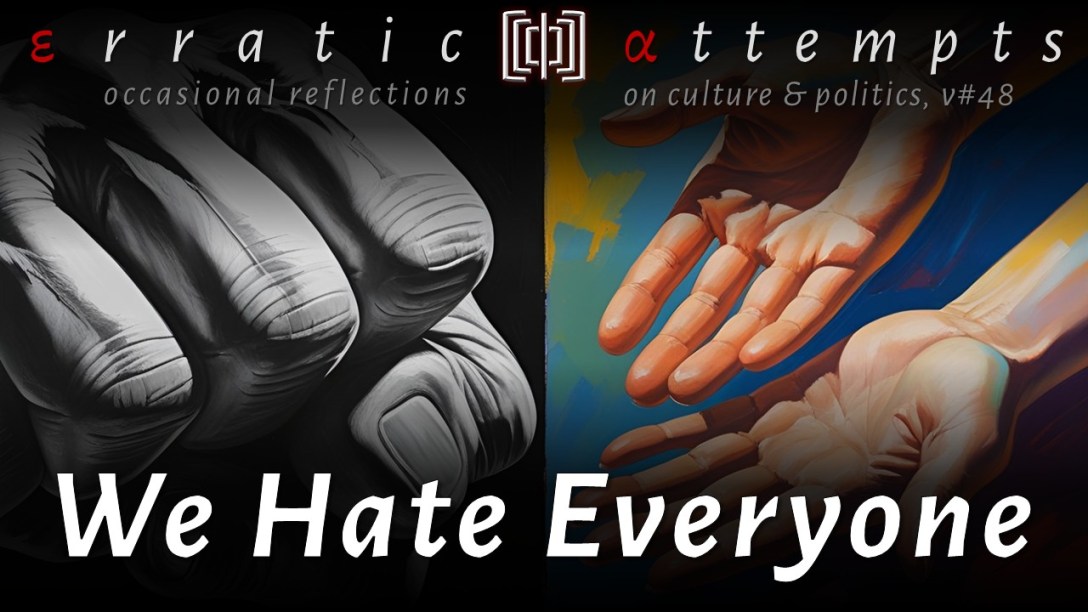
#278: We Hate Everyone: Against the Politics of Vitriol

We’ve become a "we" that thrives on disdain for differing views, a reflection of tribal instincts gone wild. Cancel culture fosters this toxicity, pushing us into rigid bubbles. Instead of embracing complexity, we dismiss and hate. It's crucial to seek understanding and compassion, dismantling these walls, rejecting hatred for a more united future.

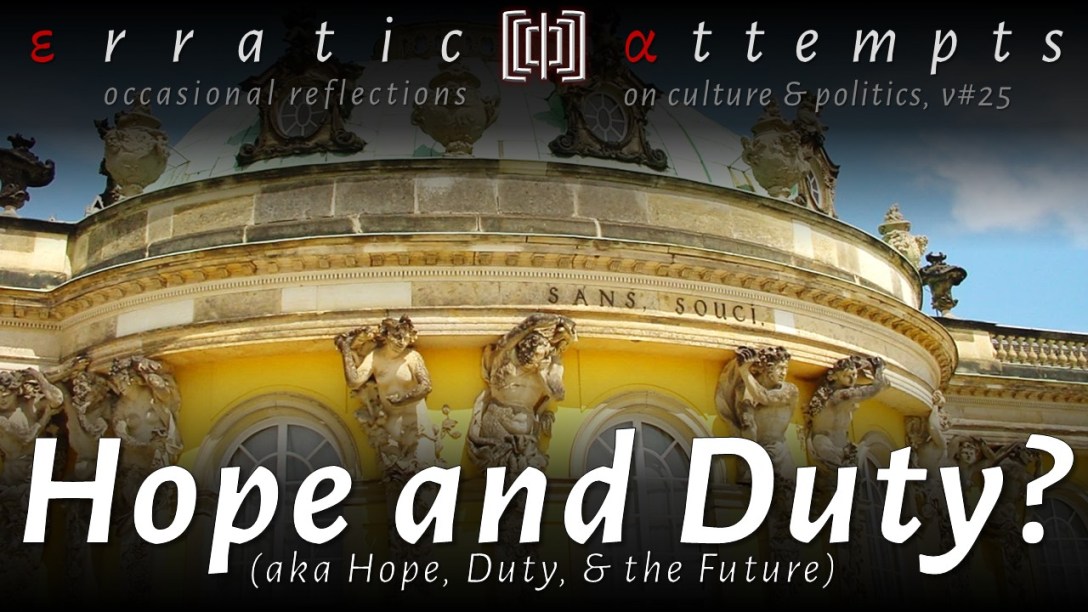
#240: Hope, Duty & the Future

Hope can be a double-edged sword—essential yet often leading to disappointment. Instead of clinging to fragile dreams, we should embrace our responsibility to others and the world. Consciously shaping the present empowers us to create a brighter future. The true essence of hope lies not in waiting but in action.

#202: Fear Not: Why We Need to be Optimistic About the Future

The post advocates for hope as a political and philosophical stance. It critiques fatalism and argues that optimism enables action, creativity, and resilience. Drawing on historical progress and human ingenuity, it calls for renewed belief in the possibility of a better world.

#200: The Nature Around Us

A contemplative meditation on nature’s beauty and fragility. The post reflects on ecological interconnectedness and the spiritual value of the natural world. It calls for environmental stewardship and a deeper appreciation of life beyond human constructs.

#199: Why Positionality Matters

The post argues that recognizing one’s positionality—social, cultural, and historical context—is essential for honest dialogue and intellectual humility. While arguments should stand on their own, identity shapes perception and bias. Acknowledging this fosters mutual respect, deeper understanding, and more constructive critique.

#197: We Have Good Reasons for Hope

Despite global crises, the post affirms that humanity possesses the tools, knowledge, and resilience to overcome challenges. It defends democracy, technological progress, and cultural evolution as sources of optimism. Hope is framed not as naïveté but as a call to action and civic engagement.

#193: De Mortuis Nil Nisi Bene: We Owe Respect to the Dead

Queen Elizabeth II’s passing is a moment to reflect on dignity, duty, and shared humanity. Criticism of her legacy should be deferred in favor of honoring the gravity of death. Respecting the dead affirms our own decency and acknowledges the fragility and significance of every human life.

#182: Reflections on Identity, Purpose, and the Active Life

Identity is not fixed but forged through action, reflection, and engagement with others. The post draws on philosophical traditions to argue that purpose emerges from lived experience, not abstract ideals. A meaningful life requires both introspection and outward commitment.

#181: Are We too Stupid for the Internet?

Digital culture rewards outrage, misinformation, and shallow engagement. The post critiques algorithmic manipulation and the erosion of attention spans, warning that democracy and reason are at risk. Reclaiming the internet requires deliberate effort to foster depth, nuance, and truth.

#171: Writing as Witnessing

Writing is an act of moral testimony. It preserves truth, confronts injustice, and affirms human dignity. In times of war and repression, the written word becomes resistance—bearing witness to suffering and refusing silence.

#164: The Answer to Death is Life

Death is confronted not with despair but with affirmation. Life must be lived fully, ethically, and creatively in the face of mortality. Meaning arises from action, love, and the refusal to surrender to nihilism.

#162: Seize the Day

Urgency is framed as a moral necessity. In times of crisis, hesitation enables injustice. Action, even imperfect, is better than paralysis. The call is to live deliberately, resist complacency, and shape history through courage.

#153: The Monstrosity of Vladimir Putin: We Have Learned Nothing From History

Putin’s actions echo the worst crimes of the 20th century. The West’s appeasement and delay mirror past failures to confront fascism. History demands vigilance, not nostalgia. Evil must be named and resisted.

#139: Nature Demands Humility: Lessons from Jurassic Park World

Jurassic Park is more than entertainment—it’s a cautionary tale about hubris. Human attempts to control nature inevitably backfire. The films illustrate how technological arrogance and corporate greed ignore ecological complexity. Real-world parallels abound, from climate change to pandemics. Nature isn’t ours to dominate; it demands respect.

#137: Live Every Day in Love

Mortality is inevitable, but meaning is found in love. Life’s purpose isn’t grand achievement—it’s the daily choice to love deeply, patiently, and without judgment. Love is the center that holds amid uncertainty. If death comes after love, it’s a good day to die.

#135: Conspiracy Belief, Science, Ego and Humility

Rejecting expertise in favor of personal intuition reflects ego, not insight. Scientific consensus exists for a reason: complexity demands specialization. The Dunning-Kruger effect explains why the least informed often feel most confident. True wisdom begins with humility and trust in collective knowledge.

#134: If People Apologize for Their Mistake, They Should Not Be Cancelled

Cancel culture punishes growth. Public apologies should be met with grace, not exile. Redemption is part of democratic discourse. Holding people accountable is necessary—but forgiveness is what makes accountability meaningful.

#133: Am I Really Not Paying Attention If I Am Not Outraged?

Outrage is not the only valid response to injustice. Thoughtfulness, reflection, and strategic action matter more than performative anger. Constant outrage can numb empathy and distort priorities. Attention must be sustainable, not reactive.

#132: My Tablet Told Me to Try a Bedtime Alarm to Get More Sleep

Technology’s nudges toward healthier habits are well-intentioned but often ineffective. Sleep hygiene requires more than reminders—it demands lifestyle change. The post reflects on digital interventions and the deeper need for self-awareness and discipline.

#131: Please Stop this Fascination with End-Times Rhetoric

Apocalyptic thinking distorts reality and undermines constructive action. Whether religious or political, end-times narratives breed fatalism and paranoia. The world is not ending—it’s evolving. Urgency must be grounded in hope, not despair.

#129: Pets Teach Empathy and How to Live

Animals communicate through emotion, gesture, and presence. Learning to understand them teaches empathy more effectively than most human interactions. Living with pets reveals the depth of nonverbal connection and reminds us that simplicity, care, and mutual recognition are the foundations of a meaningful life.

#124: Happy New Year 2022!

A brief reflection on the passage of time and the hope for renewal. The post encourages readers to embrace change, cultivate gratitude, and remain committed to truth and empathy in the year ahead.

#121: Outrage Is Not a Successful Communication Strategy

Outrage may feel cathartic but rarely persuades. Effective communication requires empathy, clarity, and respect. The post critiques performative anger and calls for more thoughtful engagement in political and social discourse.

µ#7: Can Cats Have Restless Tail Syndrome?

Restless Tail Syndrome: I think that is a thing! And it wiggles! Almost always!

#115: Are We Anthropomorphizing Human Beings?

Modern discourse often treats people as characters in simplified narratives, stripping away complexity. The post critiques this tendency and calls for deeper understanding of human behavior, beyond stereotypes and performative identity.

#114: Be Quiet Sometimes

Silence is defended as a form of wisdom. Constant commentary and reactive speech dilute meaning. The post encourages intentional quiet as a way to listen, reflect, and restore clarity in a noisy world.

#112: The Normality of Not Knowing

Uncertainty is a natural part of life. The post challenges the expectation of constant clarity and argues that embracing ambiguity fosters humility, curiosity, and resilience. Not knowing is not failure—it’s a condition of being human.

#108: Carefulness Is Not Fear

Following scientific guidance—vaccination, masking, distancing—is framed as care, not cowardice. Dismissing caution as fear reflects ignorance and moral failure. Protecting others, even those who reject protection, is a civic and ethical duty. We are our brothers’ and sisters’ keepers.

#107: How (Not) to Be Unhappy

Unhappiness often stems from flawed expectations and reactive thinking. Mindfulness, realism, and care are not the same as despair. Between happiness and misery lies a space of acceptance and effort. Problems may not be solvable, but pursuing solutions is itself a path away from unhappiness.

#106: How to Be Happy

Happiness is not a reward for success but a stance toward life’s absurdity and imperfection. Acceptance, humility, and gallows humor help navigate suffering. Meaning arises from small joys, human connection, and the decision to embrace life despite its limits.

µ#4: We Need Animals

Looking into a loving cat's eyes encapsulates pure bliss. Animals understand life's essence, and their presence enriches our existence. We should take time to connect with non-human companions, like dogs or birds. While the author favors cats, any animal can provide comfort and joy in our lives.

µ#3: Tired

A brief reflection on exhaustion—physical, emotional, and existential. The post acknowledges burnout and the need for rest, empathy, and patience. Tiredness is not weakness; it’s a signal to pause, reflect, and recalibrate.

#93: Don’t Picture This: The Trouble With Selfies

Selfies are critiqued as symbols of narcissism and digital detachment. The post explores how constant self-documentation distorts identity, undermines authenticity, and replaces experience with performance. Real presence demands stepping outside the frame.

#90: In Defense of “Wokeness”

Wokeness is defended as a moral stance rooted in empathy, justice, and historical awareness. The post critiques caricatures and argues that being “woke” means refusing complacency in the face of inequality. It’s not a fad—it’s a call to conscience.

#89: Tragedy Is the Nature of Life, and That Is OK

Life is inherently tragic—defined by mortality, fallibility, and uncertainty. Yet this truth is liberating. The post argues that embracing impermanence allows us to live more fully, ethically, and reflectively. Meaning arises not from escaping tragedy but from choosing joy and compassion within it.

#86: Nature Is Stronger than Us: The Pandemic, not the Lockdown, Is the Problem

Lockdowns are a response to the virus—not the cause of suffering. The post critiques backward reasoning and emphasizes that nature, not human policy, drives pandemics. Patience, empathy, and realism are essential. We must accept our limits and learn from history, or we’ll repeat it.

#79: The Need for the Public Understanding of Humanities and Social Science Theory

Humanities and social sciences offer essential tools for interpreting power, culture, and identity. The post argues that public discourse suffers when these disciplines are dismissed as abstract or elitist. Theory is not a luxury—it’s a framework for understanding the world and shaping democratic debate.

#73: The Destruction of Creativity through “Social” Media

Social media incentivizes conformity, performance, and instant gratification. The post warns that algorithmic culture erodes depth, originality, and risk-taking. Creativity requires solitude, slowness, and imperfection—qualities at odds with digital metrics.

#68: We Do Not Need Enemies

Yes. Russia’s actions in Crimea, Donbas, and beyond violate international law. NATO has never posed a threat; Putin’s imperial ambitions are the real danger. The post urges Russia to choose peace, democracy, and dignity over conquest and paranoia.

#67: This Perfect Virus Exploits Our Weaknesses

COVID-19 reveals our impatience, poor risk assessment, and fragile social bonds. The virus thrives on denial and division. The post urges empathy, realism, and care for relationships, warning that fear and fatigue must not erode our humanity.

#65: Sine Ira et Studio: The Strength of Dispassionate Criticism

Effective critique requires detachment, not outrage. The post defends calm, reasoned analysis as a tool for truth-seeking and democratic engagement. Passion may inspire, but only dispassion clarifies.

#63: Doubt and Faith in Religion

Faith is not certainty—it’s trust amid uncertainty. The post explores the tension between belief and doubt, arguing that true spirituality embraces questioning, humility, and the mystery of existence.

#61: We All Need to Appreciate Each Other

Appreciation is a moral and emotional necessity. The post calls for recognizing others’ dignity, contributions, and humanity. In a divided world, gratitude and empathy are revolutionary acts.

#58: Question Everything; But Also Yourself

Free thought is essential, but so is self-reflection. The post defends skepticism as a civic virtue while warning against paranoia and solipsism. True intellectual freedom includes the ability to admit error, engage others, and remain open to correction.

#55: It’s The Uncertainty That Makes Us Worry

Pandemic anxiety stems not just from danger but from unpredictability. The post reflects on psychological stress, social disruption, and the erosion of normalcy. It encourages acceptance of discomfort and small acts of grounding—like listening to cats purring—as ways to cope.

#45: Benefit of the Doubt

Moral clarity must coexist with intellectual humility. The post urges readers to resist binary thinking and extend empathy even to those they disagree with. People are rarely purely good or evil; understanding requires listening, reflection, and the courage to revise one’s views.

#42: Be the World You Want It to Be

Change begins with personal responsibility. The post affirms that ethical living, empathy, and creative action are ways to shape the world. Waiting for others to fix things is a trap. Agency is not abstract—it’s daily, deliberate, and transformative.

#41: Corona Funk

Pandemic fatigue is real. The post reflects on emotional exhaustion, isolation, and the loss of routine. It encourages readers to acknowledge their funk, seek connection, and find small rituals of renewal. Survival is not just physical—it’s psychological.

#38: Radical Empathy

Empathy must be radical—an active embrace of otherness. The post critiques self-centeredness and calls for humility, connection, and compassion. True engagement requires accepting discomfort and recognizing that difference enriches, rather than threatens, our shared humanity.

#26: Coronavirus is a Thief

The virus has stolen time, opportunity, and lives. The post reflects on the emotional and existential toll of the pandemic, urging readers to confront loss and rediscover meaning. Civilization’s veneer is thin; nature reminds us of our fragility.

#15: Happiness

Happiness is fleeting but real. Drawing on religious and historical imagery, the post affirms that joy can be carved out even amid uncertainty. Life is shaped by hope, struggle, and the refusal to surrender to despair. Transcendence is possible—moment by moment.

#12: We Are All Just Human Beings, and We Are All Predictably Stupid

Human error is universal. The post critiques arrogance, tribalism, and the illusion of superiority. Wisdom begins with humility and the recognition that stupidity is not the exception—it’s the norm. Compassion requires accepting our shared fallibility.

#3: Don’t Know What to Say

A brief reflection on speechlessness in the face of complexity or grief. The post affirms that silence can be honest, and that not knowing what to say is sometimes the most truthful response.

#2: A Fresh Start

Beginnings are framed as acts of courage. The post encourages readers to embrace change, let go of past failures, and step into new chapters with hope and intention. Renewal is always possible.

#1: Holidays

The holidays are portrayed as a time of reflection, connection, and quiet joy. The post resists commercialism and sentimentality, focusing instead on presence, gratitude, and the fragile beauty of shared time.