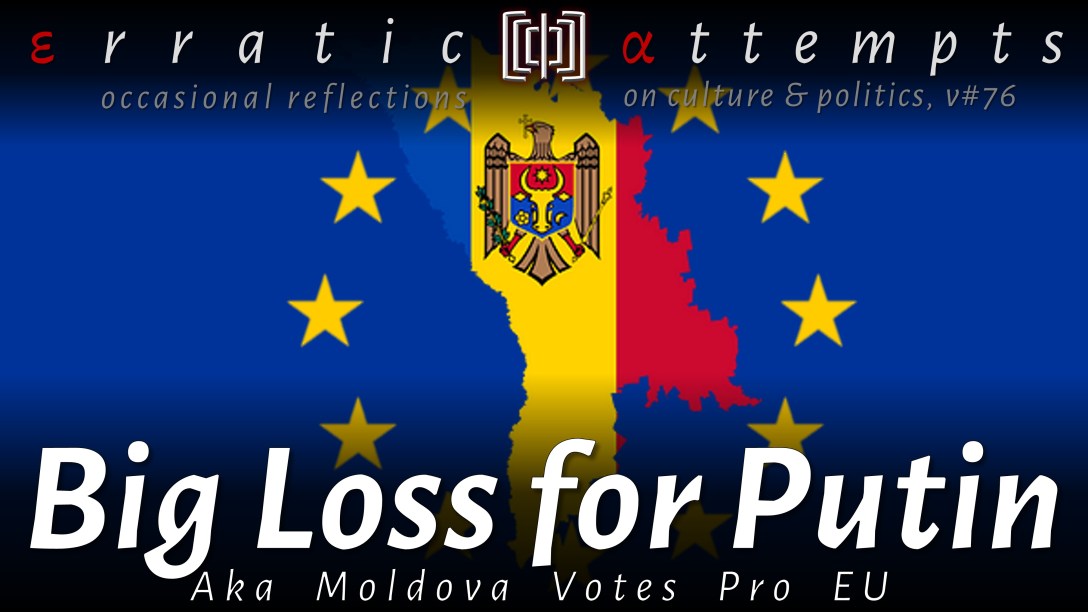
#312: Big Loss for Putin: Moldova Votes Pro EU

Maia Sandu's pro-EU party wins Moldova's elections with absolute majority, defeating Putin's influence despite massive Russian propaganda. Historic victory proves democracy prevails, EU remains attractive, and Putin's soft power crumbles. Even Europe's poorest country chooses Western integration over Russian control. Major geopolitical shift for Eastern Europe.

#297: Europe Must Step Up to Support Ukraine

Europe must wake up and act against the existential threat posed by Russia. Mere reliance on U.S. support is futile; Europe needs troops, no-fly zones, and a cohesive foreign policy. The fate of democracy in Ukraine and beyond hinges on decisive action now. Embrace strength or risk irrelevance—it's that simple.

#285: Ukraine Is Not Perfect,But Still Deserves Our Support

Ukraine’s imperfections don’t negate its right to resist invasion. The argument rejects moral absolutism and urges support for Ukraine despite its flaws. Equating criticism with abandonment is dangerous. In the face of authoritarian aggression, solidarity must be grounded not in purity, but in principle, realism, and democratic conviction.

#244: When Aliens Attack, What Will We Do? Reflections on Western Hesitancy in the Face of Russian Aggression

Using a satirical alien invasion scenario, the post critiques Western inaction in the face of Russian aggression. It argues that moral hesitation and domestic distractions undermine global leadership and embolden authoritarian regimes. The piece calls for renewed commitment to democratic values, strategic engagement, and solidarity with allies like Ukraine.

#239: Is History Helpful for Solving Conflicts?

History helps explain how conflicts arise, but relying on it to prescribe solutions can be limiting. The post argues that ideological uses of history often perpetuate division and suffering. True progress may require letting go of historical grievances to build inclusive futures, as exemplified by the European Union’s transcendence of past territorial disputes.

#220: Russia’s Only Interests Are Terror and Destruction. It Must Be Defeated

Russia’s war in Ukraine is framed as a campaign of terror with no legitimate strategic aims. The post argues that defeat is necessary to halt its imperial ambitions and restore global stability. It calls for sustained support and moral clarity in resisting authoritarian violence.

#188: What Is “The West” Today? From “Civilization” to Cooperation

The concept of “the West” is exposed as a shifting, often incoherent construct. Through maps and institutional analysis, the post argues that alliances, development, and democratic values—not geography or culture—define modernity. The term “West” ultimately collapses under scrutiny, revealing global interdependence and the need for cooperation over division.

#178: Russia Deserves Better

Putin’s regime is weakening Russia through repression, propaganda, and war. The illusion of strength masks economic decline, diplomatic isolation, and moral failure. Democracy is not alien to Russian culture—it’s a suppressed possibility. A better future requires rejecting imperialism and embracing dignity, accountability, and reform.

#176: Get Brexit Undone

Brexit has fractured the UK, weakened its global influence, and endangered peace in Northern Ireland. Cultural exceptionalism and political brinkmanship drove the decision, but its consequences are destabilizing. Rejoining Europe is framed not as surrender but as strategic recovery and moral clarity.

#170: Sanctions Against Russia Are Working – And Need to Be Even Stronger

Economic pressure is slowly eroding Russia’s capacity for war. Sanctions are painful but necessary, and their long-term impact will be decisive. The West must remain united and escalate measures to ensure accountability and deter future aggression.

#147: Why Should We Care About Ukraine? A Pragmatic Answer

Supporting Ukraine is not just a moral duty—it’s a strategic necessity. Western strength lies in alliances and shared values. Defending Ukraine affirms democracy, stability, and global credibility. The choice is stark: uphold freedom or enable authoritarian expansion.

#146: The Fall of the Soviet Union Was the Greatest Event of the Late 20th Century

Contrary to Putin’s claims, the collapse of the Soviet Union ended a brutal, imperial regime. The USSR was built on repression, genocide, and ideological tyranny. Its fall liberated millions and opened paths to democracy. Nostalgia for it insults the victims of its violence.

#144: Putin’s War Against Ukraine Is a War Against All of Us

The invasion of Ukraine is an attack on democracy, truth, and international law. It threatens global stability and moral order. Standing with Ukraine is not optional—it’s a defense of shared values and the future of free societies.

#138: The West Is not Weak, But It Has Lacked Commitment

Western democracies have failed not due to weakness but due to apathy, short-term thinking, and moral fatigue. Afghanistan’s collapse is emblematic of a broader failure to follow through. Democracy requires sustained effort, not just rhetoric. Putin’s aggression is a wake-up call: values must be defended, not assumed.

#136: Is Putin the Aggressor?

Yes. Russia’s annexation of Crimea and support for separatists in Ukraine violate international law. NATO has never threatened Russia. Putin’s narrative of victimhood is a smokescreen for imperial ambition. Peace is possible—but only through respect for sovereignty and democratic norms.

#130: German Hypocrisy: How to Claim to be a Moral Leader While Acting Like an International Free-Loader. A Polemic

Germany’s reluctance to support Ukraine and invest in defense is critiqued as moral posturing without substance. The country benefits from global stability while avoiding responsibility. True leadership requires sacrifice, not just rhetoric. Europe’s future depends on shared commitment.

#102: Brexit Means Brexit

Brexit is critiqued as a slogan masking incoherence. The phrase avoids accountability and oversimplifies complex realities. True leadership requires clarity, not repetition. The consequences of Brexit demand honest reckoning, not rhetorical deflection.

#92: The Impact of Brexit on Trade

Brexit has disrupted supply chains, increased costs, and strained UK-EU relations. The post analyzes economic consequences and argues that ideological nationalism has come at the expense of practical prosperity. Trade thrives on cooperation—not isolation.

#64: The Illusion of Brexit

Brexit is exposed as a nationalist fantasy that ignores economic and geopolitical realities. The post critiques the rhetoric of sovereignty and warns that isolation weakens Britain’s global standing and internal cohesion.