#334: The True Iranian Revolution Is Happening Now

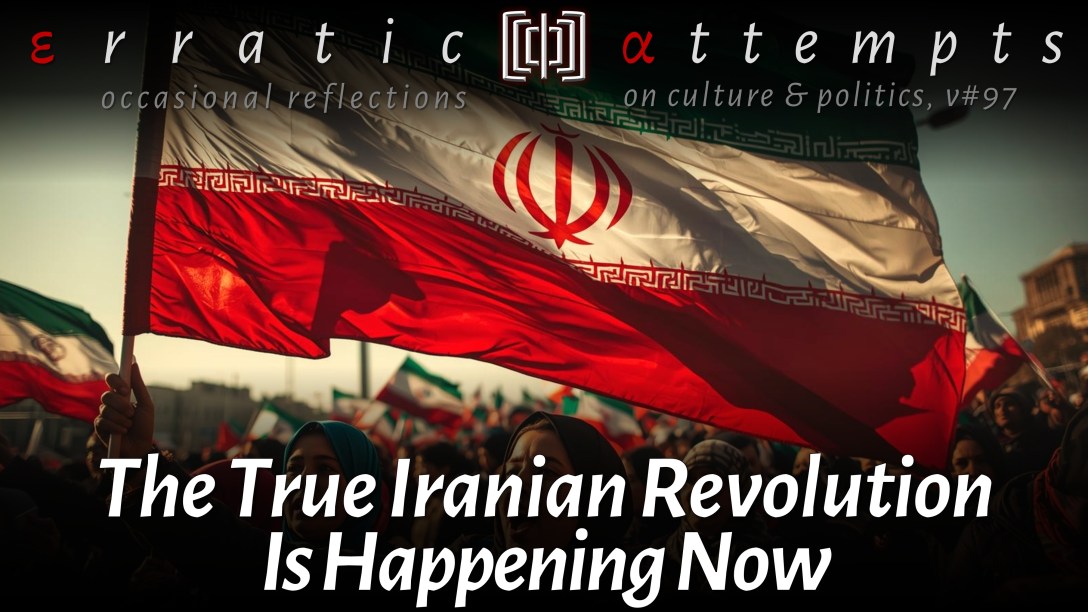
https://youtu.be/FRER-Sfl_qE What we see now in Iran is the real Iranian revolution. Let's hope they succeed. The current regime in Iran by the Mullahs claims its origin in what they call the Iranian revolution. There was indeed a regime before that that many people understood as cruel—the regime by the Shah. And so back then… Continue reading #334: The True Iranian Revolution Is Happening Now

#317: Between Enlightenment and Obscurity: Restoring the Democratic Promise of Science

Abstract This essay examines science's enlightenment ideals of transparency and democratic knowledge against modern challenges. It traces humanity through three phases—pre-civilization, pre-modern civilization, and technology-driven modernity—highlighting how constant change creates instability. The author critiques both science denial and academic obscurantism, arguing that politicizing science (as with COVID-19 and climate change) breeds mistrust. While advocating for… Continue reading #317: Between Enlightenment and Obscurity: Restoring the Democratic Promise of Science

#306: On Happiness

Happiness is a complex pursuit, intertwined with meaning and existential questioning. Drawing from thinkers like Viktor Frankl and Erich Fromm, it’s about choice and love, transcending mere pleasure. In a world plagued by suffering, true fulfillment lies not in external conditions, but in cultivating meaning and embracing our freedom to be happy.

#290: On Criticism vs. Hate

Criticism demands precision; hate thrives on generalization. The author condemns blanket judgments—whether against Russians, Israelis, Palestinians, or religious groups—and urges moral clarity. Democratic speech is a tool, not a weapon. Conflating critique with prejudice empowers extremism and erodes civic responsibility. Precision, not passion alone, defines ethical dissent.

#276: Is There an Easy and Fast Way to Know What is True or False?

Truth isn't a quick fix; it's a relentless pursuit fraught with complexities. We often confuse knowledge with understanding, mistakenly believe consensus equals correctness, and underestimate the power of questions. Competing truths exist alongside facts, and in an AI-driven world, discerning reality is more vital than ever. Brace yourself—truth is hard work.

#256: Words Are Not Violence, But They Can Promote It

In a world spiraling into hate-fueled polarization, the author urges an urgent change of heart. Words may not hurt, but they lead to violence and societal decay. Rejecting the humanity of others poisons us all. Love and respect must triumph over judgment if democracy—and humanity—are to endure.

#249: The Resistance Against Wokeness, Part II: Addressing Religious Objections

Religious objections to “wokeness” are examined through Abrahamic traditions, emphasizing mercy, humility, and the fallibility of human judgment. The post critiques literalist interpretations used to justify discrimination and highlights scriptural calls for compassion. It argues that true faith supports dignity and inclusion, while cautioning against moral arrogance on all sides of the debate.

#248: The Resistance Against Wokeness, Part I

The post explores the backlash against “wokeness,” tracing its roots to cultural, religious, and political discomfort with systemic critiques of racism, gender norms, and social justice. It argues that resistance often stems from a misunderstanding of sin, fallibility, and humility, and critiques the idolization of rugged masculinity and traditionalism as barriers to empathy and progress.

#240: Hope, Duty & the Future

Hope can be a double-edged sword—essential yet often leading to disappointment. Instead of clinging to fragile dreams, we should embrace our responsibility to others and the world. Consciously shaping the present empowers us to create a brighter future. The true essence of hope lies not in waiting but in action.

#229: Fighting for Love in Times of War

Amid war and hatred, the post calls for a radical commitment to love, empathy, and human dignity. It argues that emotional resilience and moral courage are essential to resisting dehumanization. Love is framed not as naïve sentiment, but as a political and ethical stance against violence and despair.

#225: Religion, Transcendence & Nature

The post explores the intersection of religion, transcendence, and nature, arguing that spiritual experience is deeply rooted in the natural world. It critiques dogmatic theology and calls for a more open, experiential understanding of the divine. Nature is presented as a source of awe, ethical reflection, and existential insight.

#206: The Importance of Being Political

Political engagement is presented as a moral and civic duty. The post critiques apathy and argues that being “unpolitical” enables authoritarianism. Drawing on Pericles, Kant, and liberation theology, it calls for critical thinking, public discourse, and active participation in shaping society. Citizenship is framed as both a right and a responsibility.

#202: Fear Not: Why We Need to be Optimistic About the Future

The post advocates for hope as a political and philosophical stance. It critiques fatalism and argues that optimism enables action, creativity, and resilience. Drawing on historical progress and human ingenuity, it calls for renewed belief in the possibility of a better world.

#199: Why Positionality Matters

The post argues that recognizing one’s positionality—social, cultural, and historical context—is essential for honest dialogue and intellectual humility. While arguments should stand on their own, identity shapes perception and bias. Acknowledging this fosters mutual respect, deeper understanding, and more constructive critique.

#193: De Mortuis Nil Nisi Bene: We Owe Respect to the Dead

Queen Elizabeth II’s passing is a moment to reflect on dignity, duty, and shared humanity. Criticism of her legacy should be deferred in favor of honoring the gravity of death. Respecting the dead affirms our own decency and acknowledges the fragility and significance of every human life.

#184: Anecdotal Thinking, Science, Religion, and Policy

Anecdotes distort public understanding of science and policy. The post critiques emotional reasoning in debates about religion, health, and governance, arguing for evidence-based thinking. While stories can inspire, they must not replace rigorous analysis in shaping collective decisions.

#182: Reflections on Identity, Purpose, and the Active Life

Identity is not fixed but forged through action, reflection, and engagement with others. The post draws on philosophical traditions to argue that purpose emerges from lived experience, not abstract ideals. A meaningful life requires both introspection and outward commitment.

#181: Are We too Stupid for the Internet?

Digital culture rewards outrage, misinformation, and shallow engagement. The post critiques algorithmic manipulation and the erosion of attention spans, warning that democracy and reason are at risk. Reclaiming the internet requires deliberate effort to foster depth, nuance, and truth.

#179: Ecce Homo: Wokeness Beyond Caricatures

Wokeness is reframed as a call to critical compassion—an ethical stance rooted in self-awareness, social justice, and urgency. Rather than a caricature, it’s presented as a moral imperative to confront societal flaws with grace and resolve. Justice, not retribution; inclusion, not exclusion; hope, not cynicism.

#167: The Pseudo-Problem of Theodicy and the Nature of Divinity

Theodicy is reframed as a human misunderstanding of divinity. Good and evil are anthropocentric categories, and expecting divine justice reflects unrealistic projections. God, if anything, must be understood as transcending human attributes and concerns. Justice is our responsibility—not a divine guarantee.

#139: Nature Demands Humility: Lessons from Jurassic Park World

Jurassic Park is more than entertainment—it’s a cautionary tale about hubris. Human attempts to control nature inevitably backfire. The films illustrate how technological arrogance and corporate greed ignore ecological complexity. Real-world parallels abound, from climate change to pandemics. Nature isn’t ours to dominate; it demands respect.

#137: Live Every Day in Love

Mortality is inevitable, but meaning is found in love. Life’s purpose isn’t grand achievement—it’s the daily choice to love deeply, patiently, and without judgment. Love is the center that holds amid uncertainty. If death comes after love, it’s a good day to die.

#135: Conspiracy Belief, Science, Ego and Humility

Rejecting expertise in favor of personal intuition reflects ego, not insight. Scientific consensus exists for a reason: complexity demands specialization. The Dunning-Kruger effect explains why the least informed often feel most confident. True wisdom begins with humility and trust in collective knowledge.

#129: Pets Teach Empathy and How to Live

Animals communicate through emotion, gesture, and presence. Learning to understand them teaches empathy more effectively than most human interactions. Living with pets reveals the depth of nonverbal connection and reminds us that simplicity, care, and mutual recognition are the foundations of a meaningful life.

#116: Religion Is Trust in the Universe

Religion is reframed as existential trust—a belief in meaning, order, and connection beyond oneself. The post critiques dogma and presents spirituality as a posture of openness, humility, and ethical engagement with the unknown.

#115: Are We Anthropomorphizing Human Beings?

Modern discourse often treats people as characters in simplified narratives, stripping away complexity. The post critiques this tendency and calls for deeper understanding of human behavior, beyond stereotypes and performative identity.

#114: Be Quiet Sometimes

Silence is defended as a form of wisdom. Constant commentary and reactive speech dilute meaning. The post encourages intentional quiet as a way to listen, reflect, and restore clarity in a noisy world.

#112: The Normality of Not Knowing

Uncertainty is a natural part of life. The post challenges the expectation of constant clarity and argues that embracing ambiguity fosters humility, curiosity, and resilience. Not knowing is not failure—it’s a condition of being human.

#111: Faith, the Pandemic, and the Drowning Man

Faith is explored through a parable of missed opportunities. The post critiques passive religiosity and calls for active engagement with reality. True belief requires action, not just hope.

#110: Poem: To Understand the World

A poetic reflection on perception, empathy, and the limits of knowledge. The speaker seeks to grasp the world’s complexity through feeling and imagination, affirming that understanding begins with openness.

#99: Anti-Zionism Is Anti-Semitism

Opposing Israel’s existence under the guise of anti-Zionism is framed as a form of antisemitism. The post argues that denying Jewish self-determination while accepting it for other groups reflects a double standard. Criticism of Israeli policy is legitimate, but rejection of Israel’s right to exist crosses into bigotry.

#89: Tragedy Is the Nature of Life, and That Is OK

Life is inherently tragic—defined by mortality, fallibility, and uncertainty. Yet this truth is liberating. The post argues that embracing impermanence allows us to live more fully, ethically, and reflectively. Meaning arises not from escaping tragedy but from choosing joy and compassion within it.

#88: Nature Is the Best Meditation

Meditation doesn’t require technique—it requires presence. Nature offers the most accessible path to mindfulness by decentering the self and inviting attention to the world beyond us. The post encourages readers to sit still, observe, and rediscover humility through the breath of the world.

#86: Nature Is Stronger than Us: The Pandemic, not the Lockdown, Is the Problem

Lockdowns are a response to the virus—not the cause of suffering. The post critiques backward reasoning and emphasizes that nature, not human policy, drives pandemics. Patience, empathy, and realism are essential. We must accept our limits and learn from history, or we’ll repeat it.

#74: On the Difference Between Scientific and Mythological Thinking

Scientific thinking is empirical, provisional, and self-correcting. Mythological thinking is symbolic, moral, and narrative-driven. The post argues that both have value, but confusing them leads to epistemological chaos. Science explains; myth interprets. We need both—but must know which is which.

#63: Doubt and Faith in Religion

Faith is not certainty—it’s trust amid uncertainty. The post explores the tension between belief and doubt, arguing that true spirituality embraces questioning, humility, and the mystery of existence.

#61: We All Need to Appreciate Each Other

Appreciation is a moral and emotional necessity. The post calls for recognizing others’ dignity, contributions, and humanity. In a divided world, gratitude and empathy are revolutionary acts.

#59: Why Really Big Conspiracies Cannot Exist

Large-scale conspiracies are implausible because they require too many people to remain silent, too much coordination, and too little evidence. The post argues that human fallibility, institutional complexity, and the sheer scale of modern systems make sustained deception virtually impossible.

#53: What Is “Left”? A Very Erratic Attempt

The left is defined not by dogma but by a commitment to justice, equality, and critical thought. The post explores the fragmentation of leftist politics and calls for a renewed focus on substance over identity, solidarity over purity, and pragmatism over posturing.

#49: Nature Demands Humility

Human arrogance blinds us to ecological reality. The post argues that nature is not a resource to be mastered but a force to be respected. Climate change, pandemics, and extinction are consequences of hubris. Survival depends on humility, restraint, and reverence.

#45: Benefit of the Doubt

Moral clarity must coexist with intellectual humility. The post urges readers to resist binary thinking and extend empathy even to those they disagree with. People are rarely purely good or evil; understanding requires listening, reflection, and the courage to revise one’s views.

#37: Coronavirus, the Amfortas Wound?

COVID-19 is likened to Amfortas’s unhealing wound—a crisis worsened by denial, mismanagement, and hubris. The post critiques global responses and warns that reopening too soon invites resurgence. Hope is necessary, but only discipline and care will lead to healing.

#27: What is Peace?

Peace is not passivity—it’s an active, disciplined state of compassion and humility. The post argues that peace must be both the goal and the method. Even in conflict, reconciliation must remain possible. Inner peace is a prerequisite for outer peace.

#24: Conspiracy Thinking is Not Critical Thinking

Conspiracies thrive on distrust and false logic. The post critiques the misuse of skepticism and defends science, transparency, and reason. True critical thinking requires evidence, humility, and openness—not paranoia and tribalism.

#18: What’s Left: Communism, Socialism, Progressivism, Social Democracy, and the Value of Dissent

Leftist thought must reject dogma and embrace ruthless criticism. The post traces Marx’s emphasis on intellectual freedom and warns against utopianism. True progressivism lies in democratic skepticism, not ideological purity. Social democracy, not authoritarian socialism, is the viable path forward.

#17: Coronavirus: This is the Apocalypse

Apocalypse means revelation—not destruction. The pandemic exposes systemic flaws: overreliance on global supply chains, lack of transparency, and erosion of democratic norms. The post calls for global cooperation, scientific discipline, and renewed commitment to human rights.

#15: Happiness

Happiness is fleeting but real. Drawing on religious and historical imagery, the post affirms that joy can be carved out even amid uncertainty. Life is shaped by hope, struggle, and the refusal to surrender to despair. Transcendence is possible—moment by moment.