#296: Putin’s Mistakes

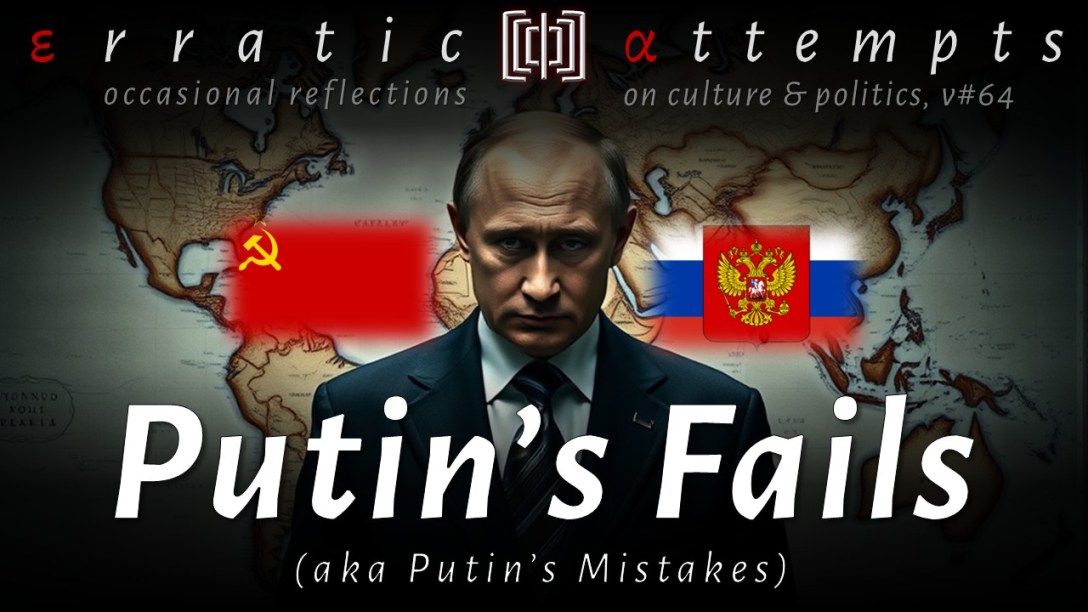
Putin’s hubris has led him to grave miscalculations, underestimating both the resilience of the West and the consequences of his authoritarian reign. His dismissal of opposition and reliance on natural resources over innovation have stagnated Russia, proving that true strength lies in the system, not the ruler. The war's toll is ultimately self-defeating.

#244: When Aliens Attack, What Will We Do? Reflections on Western Hesitancy in the Face of Russian Aggression

Using a satirical alien invasion scenario, the post critiques Western inaction in the face of Russian aggression. It argues that moral hesitation and domestic distractions undermine global leadership and embolden authoritarian regimes. The piece calls for renewed commitment to democratic values, strategic engagement, and solidarity with allies like Ukraine.

#219: Some Reflections on Fukuyama and the End of History

Fukuyama’s thesis is revisited in light of contemporary authoritarian resurgence. The post critiques premature triumphalism and argues that democracy remains fragile and contested. It calls for renewed philosophical engagement with history, ideology, and the conditions of freedom.

#207: Democracy Only Works with a Strong Separation of Powers

The post argues that liberal democracy depends on institutional checks and balances. Drawing on historical examples from Athens, Rome, and Weimar Germany, it warns against populist erosion of judicial and legislative independence. Democracy is framed not as majority rule, but as a system that protects individual rights through structural safeguards.

#188: What Is “The West” Today? From “Civilization” to Cooperation

The concept of “the West” is exposed as a shifting, often incoherent construct. Through maps and institutional analysis, the post argues that alliances, development, and democratic values—not geography or culture—define modernity. The term “West” ultimately collapses under scrutiny, revealing global interdependence and the need for cooperation over division.

#151: Putin Is a Fascist per Definition

Putin’s regime meets the criteria of fascism: ultranationalism, suppression of dissent, glorification of violence, and cult of personality. Denial of this reality enables complicity. The label is not rhetorical—it’s descriptive.

#91: The Transatlantic Perspective Needs to be Global

Western alliances must expand their worldview beyond Euro-American interests. The post calls for inclusive diplomacy, recognizing the agency of non-Western nations. A truly global perspective requires listening, learning, and sharing power.

#83: The Purpose of History, or, We Need to Explain Democracy Better

History is a tool for understanding—not just remembering. The post calls for better civic education to explain democracy’s value, complexity, and fragility. Without historical context, democratic ideals risk being misunderstood or abandoned.

#54: The Dictator as False Messiah: A Belated Review of Game Of Thrones Season 8

Game of Thrones’ final season is interpreted as a political allegory. Daenerys embodies the seductive danger of authoritarian idealism. The post critiques the narrative arc as a warning against messianic leadership and the collapse of democratic institutions under charismatic rule.

#14: The European Project Needs Both Unity and Disunity

Europe’s strength lies in its tension between integration and independence. The post defends pluralism, subsidiarity, and the coexistence of national identity with shared values. Unity must not erase difference; disunity must not undermine solidarity.