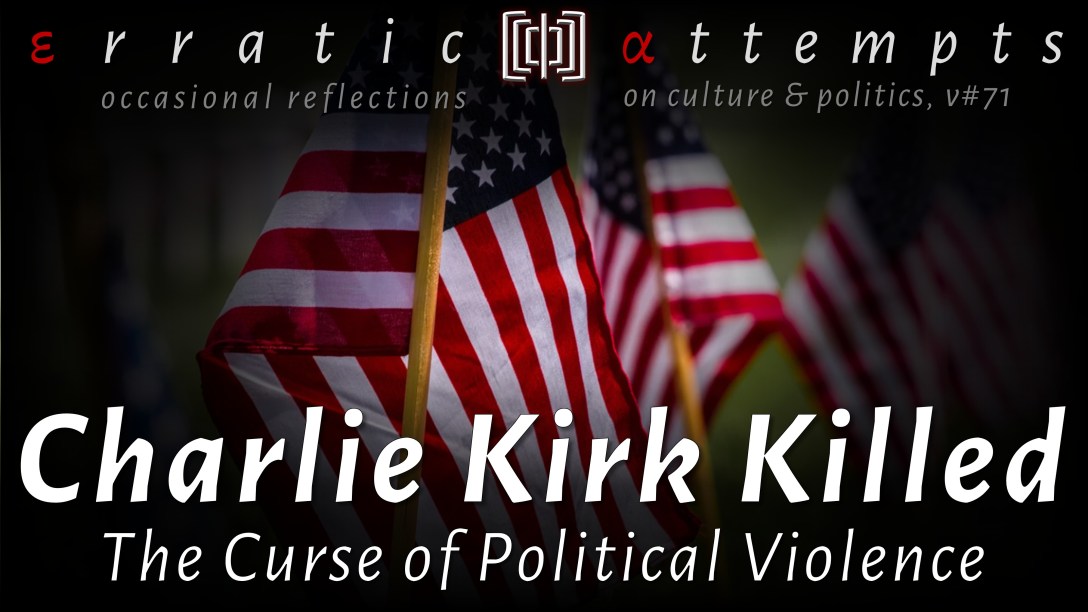
#307: Charlie Kirk Killed. The Curse of Political Violence

A passionate condemnation of Charlie Kirk's assassination, calling for an end to political violence. Despite disagreeing with Kirk's politics, the speaker emphasizes that political engagement shouldn't result in death. The message argues that democracy requires people willing to serve and debate, not violence that silences opposing voices.

#286: Democracy Needs Humility

In a world tainted by partisan divide, the essence of democracy hinges on humility and listening to all voices. Politicians must ditch blind loyalty, embrace complexity, and recognize that people's values matter more than rigid ideologies. Only then can true democracy flourish, transcending the toxic tribalism gripping political discourse today.

#259: These Insults Need to Stop

The normalization of political insults in American discourse undermines democratic culture and public trust. The post critiques inflammatory rhetoric from both major parties, arguing that such behavior degrades civic responsibility and distracts from substantive issues. It calls for a return to decency, mutual respect, and serious engagement with the challenges of governance—urging voters to reject spectacle and demand accountability.

#206: The Importance of Being Political

Political engagement is presented as a moral and civic duty. The post critiques apathy and argues that being “unpolitical” enables authoritarianism. Drawing on Pericles, Kant, and liberation theology, it calls for critical thinking, public discourse, and active participation in shaping society. Citizenship is framed as both a right and a responsibility.

#184: Anecdotal Thinking, Science, Religion, and Policy

Anecdotes distort public understanding of science and policy. The post critiques emotional reasoning in debates about religion, health, and governance, arguing for evidence-based thinking. While stories can inspire, they must not replace rigorous analysis in shaping collective decisions.

#171: Writing as Witnessing

Writing is an act of moral testimony. It preserves truth, confronts injustice, and affirms human dignity. In times of war and repression, the written word becomes resistance—bearing witness to suffering and refusing silence.

#156: Politics, Arts and Sports: Some Erratic Reflections

Art and performance are inherently political. Silence in the face of tyranny is complicity. Artists like Gergiev and Riefenstahl illustrate the spectrum from resistance to propaganda. True art demands introspection and moral clarity.

#129: Pets Teach Empathy and How to Live

Animals communicate through emotion, gesture, and presence. Learning to understand them teaches empathy more effectively than most human interactions. Living with pets reveals the depth of nonverbal connection and reminds us that simplicity, care, and mutual recognition are the foundations of a meaningful life.

#25: Legitimate and Illegitimate Arguments Regarding the Coronavirus Shutdown

The post categorizes pandemic-related claims by their ethical and scientific merit. Legitimate concerns include economic hardship and mental health; illegitimate ones include denialism and conspiracy theories. Public health must balance individual freedom with collective responsibility.

#21: Media: Don’t Tell People What To Think

Media shape how we think, not what we think. The post explores framing, agenda-setting, and narrative influence, arguing that awareness—not rejection—is the key to navigating information. Blaming media oversimplifies complex dynamics.

#11: Authoritarian Governments Must Lie, and Democracies are Grown-Up Systems

Authoritarian regimes rely on deception to maintain control. Democracies, by contrast, embrace transparency and self-correction. The post defends democratic messiness as a sign of maturity, arguing that truth and accountability are essential to legitimacy.

#9: Dialectical Thinking

Dialectics is framed as a method of intellectual humility—an openness to contradiction, synthesis, and revision. The post critiques binary thinking and defends complexity as essential to truth-seeking. Real understanding requires tension, not resolution.

#5: Democracy Means Humility

Democracy demands the recognition that others may know what they’re doing—even if we disagree. The post critiques tribalism and partisan arrogance, affirming that inclusion, fallibility, and dialog are the foundations of democratic life.