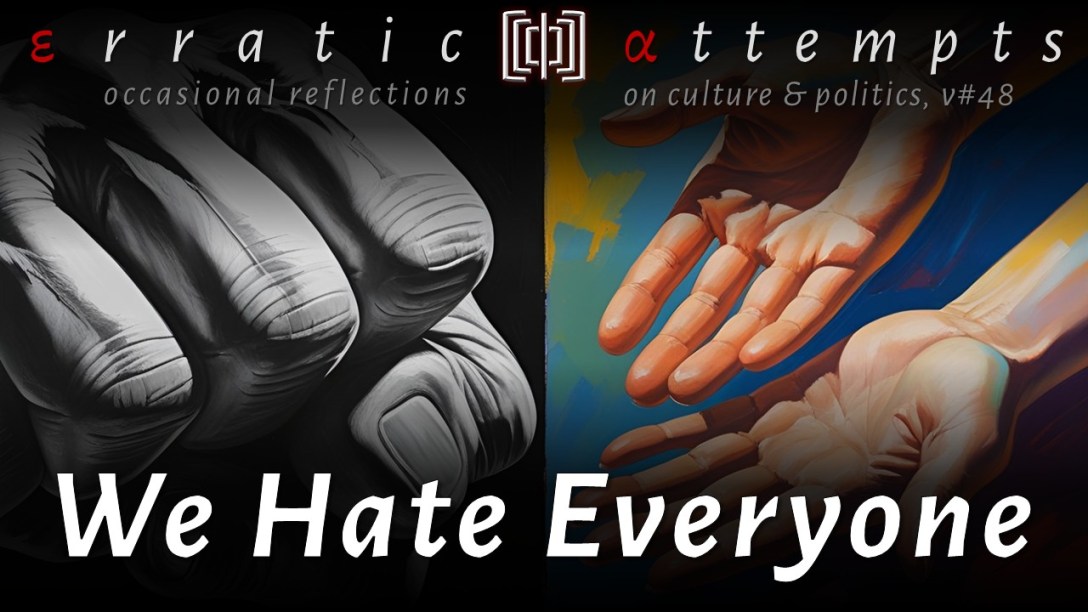
Criticism demands precision; hate thrives on generalization. The author condemns blanket judgments—whether against Russians, Israelis, Palestinians, or religious groups—and urges moral clarity. Democratic speech is a tool, not a weapon. Conflating critique with prejudice empowers extremism and erodes civic responsibility. Precision, not passion alone, defines ethical dissent.
Tag: Hamas
#282: Enough Already. Hamas is Sufficiently Weakened, and People Need a Future
#278: We Hate Everyone: Against the Politics of Vitriol
We’ve become a "we" that thrives on disdain for differing views, a reflection of tribal instincts gone wild. Cancel culture fosters this toxicity, pushing us into rigid bubbles. Instead of embracing complexity, we dismiss and hate. It's crucial to seek understanding and compassion, dismantling these walls, rejecting hatred for a more united future.
#264: Freedom from Assad
The fall of Bashar al-Assad is presented as a victory for Syria and humanity, marking the end of a brutal regime responsible for torture, repression, and regional instability. The post links Assad’s defeat to the weakening of Russian and Iranian influence, and highlights Turkey’s role in supporting Syrian liberation. It raises questions about Syria’s future, emphasizing the need for moderation, justice, and democratic governance. The conclusion reflects on Syria’s ancient civilizational legacy and expresses hope for a more peaceful and dignified future for its people.
#252: Some Reflections on Israel, Gaza, and Protests
The post reflects on the Israel-Gaza conflict and the global protests surrounding it, emphasizing the need for moral clarity and historical awareness. It critiques simplistic narratives that equate both sides, arguing that Israel’s right to exist and defend itself must be acknowledged alongside Palestinian suffering. The analysis warns against ideological extremism and calls for a balanced, humane approach rooted in justice, empathy, and democratic values.
#241: The War Against Israel
The post defends Israel’s right to exist and respond to aggression, while acknowledging the suffering of Palestinians. It critiques anti-Israel rhetoric that veers into antisemitism and calls for a nuanced understanding of the conflict rooted in history, justice, and the protection of democratic values.
#238: Kristallnacht, 85 Years Later
Eighty-five years after Kristallnacht, the post reflects on the enduring lessons of that night of terror. It emphasizes the importance of historical memory in resisting antisemitism and authoritarianism today. The analysis warns against moral relativism and the normalization of hate, arguing that silence and indifference remain complicit. Remembering Kristallnacht is framed as a moral obligation to defend human dignity and democratic values in the face of rising extremism.
#234: Israel is Neither Colonizer Nor Apartheid State
The post refutes claims that Israel is a colonial or apartheid state, arguing that such labels distort history and ignore the region’s complex realities. It emphasizes Israel’s democratic structure, diverse population, and existential vulnerability. The analysis warns that misusing these terms undermines legitimate critique and fuels antisemitic narratives.
#230: Against Hamas, Against Antisemitism, Against Antizionism
The post condemns Hamas’s violence, rising antisemitism, and ideological antizionism. It argues that criticism of Israeli policy must not devolve into denial of Israel’s right to exist. The analysis calls for moral clarity in distinguishing between legitimate protest and hate, defending both Jewish identity and Palestinian dignity.
#229: Fighting for Love in Times of War
Amid war and hatred, the post calls for a radical commitment to love, empathy, and human dignity. It argues that emotional resilience and moral courage are essential to resisting dehumanization. Love is framed not as naïve sentiment, but as a political and ethical stance against violence and despair.
#228: Hamas Attacked Israel
The post documents and condemns Hamas’s attack on Israel, emphasizing the brutality and ideological extremism behind it. It argues that the assault was not a spontaneous uprising but a calculated act of terror. The analysis calls for solidarity with victims and a rejection of narratives that justify or minimize such violence.
#99: Anti-Zionism Is Anti-Semitism
Opposing Israel’s existence under the guise of anti-Zionism is framed as a form of antisemitism. The post argues that denying Jewish self-determination while accepting it for other groups reflects a double standard. Criticism of Israeli policy is legitimate, but rejection of Israel’s right to exist crosses into bigotry.