
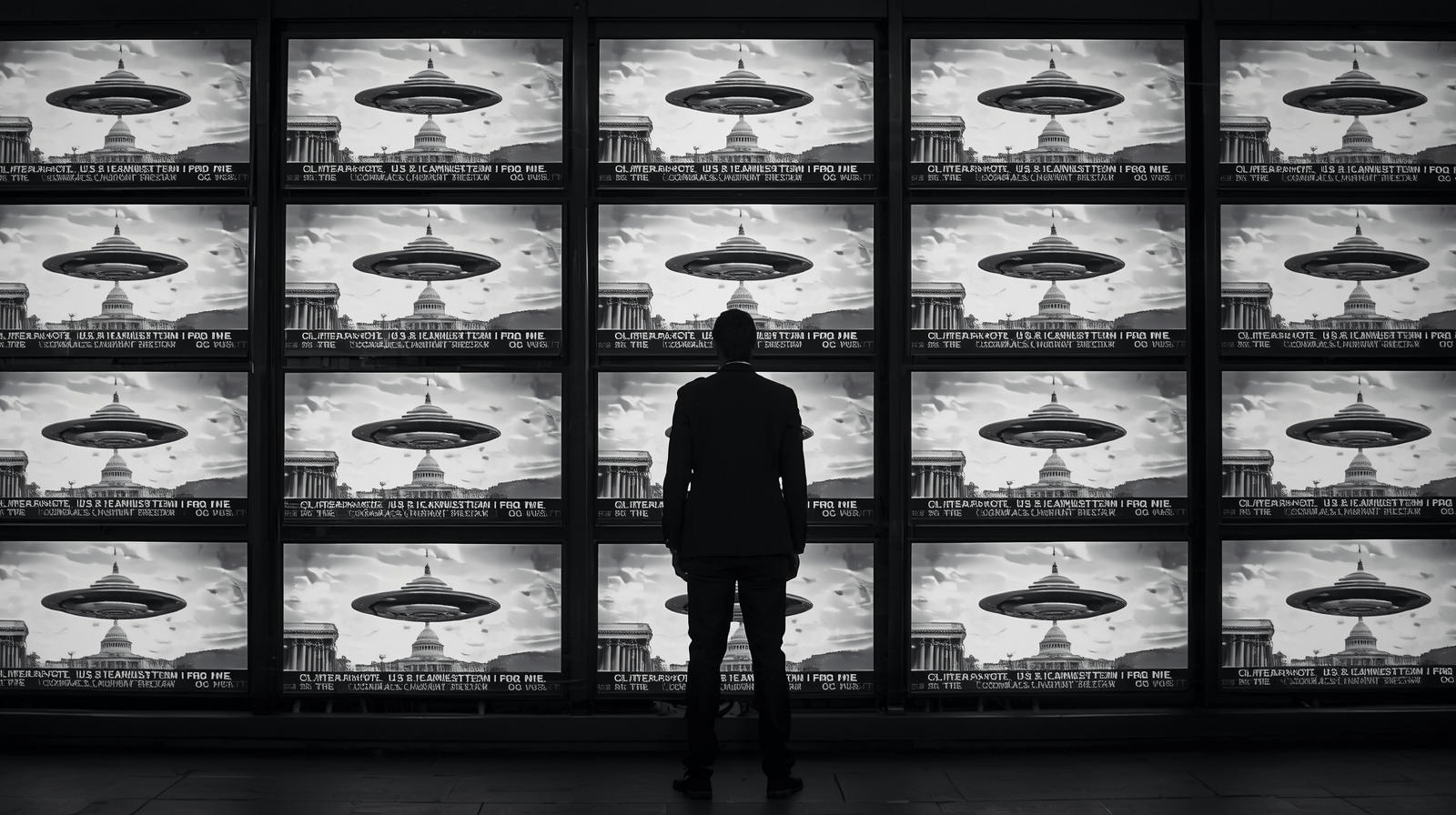
Preliminaries
Journal Version:
This is an expanded preprint version of the journal article published as “The Paranormal Counter-Public: The Impact of Platform Mediatization on the UAP Disclosure Discourse in American Politics” in: Mediatization Studies. Vol. 9 (2025). pp. 119-130.
Expanded Print Version:
A PDF version is available for print.
Abstract:
This paper examines how mediatization processes in digital environments fundamentally transform political authority construction and democratic knowledge production. Drawing on mediatization theory and platform studies, the research analyzes how different media logics create divergent information ecosystems, enabling non-traditional actors to construct alternative forms of epistemic authority that can influence mainstream institutions while operating outside traditional gatekeeping mechanisms. Using UAP (Unexplained Anomalous Phenomena) discourse as a critical case study, systematic analysis of media platforms from 2017-2025 demonstrates the migration of political discourse from institutional to algorithmic curation, facilitating the formation of “paranormal counterpublics” that transcend conventional left-right divisions. The study reveals how platform-specific affordances—duration flexibility, algorithmic amplification, and parasocial relationships—alter epistemological frameworks through which audiences evaluate evidence and expertise. These findings illuminate broader democratic transformations in how societies negotiate boundaries between legitimate and illegitimate knowledge claims, allocate speaking authority, and legitimate political action in an increasingly mediatized world.
Keywords:
Mediatization Theory, Platform Studies, Political Authority, Media Logic, Counterpublics, Epistemic Authority, Digital Platforms, UAP Discourse, Algorithmic Curation, Democratic Knowledge Construction
Table of Contents:
- Introduction
- Theoretical Framework and Methodology
- The UAP Taskforce between Traditional vs. Alternative Media Logics
- Conspiracy and Hauntology: Trauma and Paranoid Narratives in US Culture
- Alternative Truths: Aliens, Artificial Intelligence, and Consciousness
- A Paranormal Counter-Public? (Alt-)Truth, Media, and the New Counterculture
- Analysis and Conclusions: Mediatized Post-Truth and the Paranormal Counter-Public
- Epilogue: Is the Truth Out There?
- References
- Appendix
1. Introduction
This paper examines how media coverage of fringe topics demonstrates the declining influence of traditional media compared to internet-driven platforms, which now wield stronger political power in shaping public discourse and political agenda-setting. Especially discourses around topics considered fringe or outside the norm illustrate the fundamental transformations in how an increasingly global society negotiates the boundaries between legitimate and illegitimate knowledge claims, and how media drives this discussion.
The topic illustrates these developments, namely the reporting on possible disclosure of the truth behind Unexplained Anomalous Phenomena (UAPs, formerly UFOs), which can be characterized as alternatingly confusing, frustrating, fringe, or potentially groundbreaking. Since the pivotal article by Blumenthal et al. (2017) in the New York Times — one of the rare occasions we will see major established media playing an active role in this discourse —, there have been whistleblower reports, Congressional hearings, and increased media coverage, especially on the upstart television station NewsNation (which has a large online footprint), YouTube and other podcasting sites. A governmental task force has been established with a stated commitment to reveal the truth. These developments raise fundamental questions about media transformation, political authority construction, and democratic transparency in the digital age.
This article is not about the nature of UAPs, or whether they represent genuine anomalous phenomena, but rather how and where the topic is reported and how the migration of serious political discourse from traditional to alternative media platforms reveals broader changes in American if not global political culture. By tracing UAP coverage within American media ecosystems, we can track political changes in what constitutes a new Paranormal counterculture, especially its shift from the conventional political left to libertarian, alternative and new conservative spaces. Overall, there is a political realignment that has been pushing these already simplified political coordinates to the breaking point, with online media formats located at the forefront of this development.
To appropriate a key thesis by political theorist Herfried Münkler (2007), just as empires are challenged oftentimes not from the imperial center but from its borderlines, its frontier regions, so are media empires challenged by their respective frontiers, be they technological, geographical, or biopolitical i.e. generational.
This brings with it the need to situate this discourse within Mediatization theory, which asks a question as old as Plato’s Phaedrus dialog (274c-275c): How do new media inventions (in Plato’s case, writing) change human behavior, and with this, how are they driving developments in human societies, cultures and eventually politics? We will return to this; but let us first introduce the central thesis and research questions.
1.1. Central Thesis:
The UAP disclosure discourse provides a critical case study for understanding how mediatization processes in digital environments enable the formation of alternative political authorities that can influence mainstream institutions while mostly operating outside traditional gatekeeping mechanisms. A specialized audience drives the discourse through algorithmic reinforcement by electronic media platforms, and traditionally established gatekeepers can be more frequently circumvented.
This article follows a grounded theory approach, drawing from recent media content and applying mediatization theory, public sphere concepts, and platform studies methodologies. Due to its contemporary focus, it relies on systematic analysis of journalistic sources, congressional transcripts, and digital media content to examine changes in both the media landscape and mediatized political processes.
2. Theoretical Framework and Methodology
2.1. Research Questions and Hypotheses
This study addresses three primary research questions that illuminate broader patterns of media transformation and political authority migration:
Question 1: How do different media logics shape the presentation and reception of the discourse pertaining to UAP (Unidentified Anomalous Phenomena) across traditional and alternative platforms?
Question 2: What role does platform architecture play in enabling what are socially understood to be fringe topics to gain mainstream political legitimacy?
Question 3: How does the mediatization of political discourse enable non-traditional actors to construct alternative forms of epistemic authority?
Which leads us to the following hypotheses:
Hypothesis 1: The institutional gatekeeping mechanisms of (most) traditional media systematically exclude or marginalize UAP discourse after initial coverage, while the engagement-driven algorithms of digital platforms amplify such content, creating divergent information ecosystems. This is independent of the truth value of the content, both in traditional and new media.
Hypothesis 2: Platform-specific affordances (long-form conversation, algorithmic curation, parasocial relationships) fundamentally alter the epistemological framework through which audiences evaluate evidence and expertise.
Hypothesis 3: The migration of the UAP discourse from mainstream to alternative media, combined with the new possibilities of online platforms reflect broader transformations in how political authority is constructed and legitimized in digital environments.
But first, let us review some theoretical foundations pertaining to theories of media, politics and mediatization.
2.2. Theoretical Foundation: From Media Theory to Mediatization
From Plato to McLuhan
Plato may have been the first, but Plato frequently simply is the first. In his Phaedrus dialog, the Egyptian God Theuth praises the invention of writing for making his people wiser, whereas king Thamus disagrees:
“You have invented an elixir not of memory, but of reminding; and you offer your pupils the appearance of wisdom, not true wisdom, for they will read many things without instruction and will therefore seem to know many things, when they are for the most part ignorant and hard to get along with, since they are not wise, but only appear wise” (Plato, Phaedrus, 274e-275b).
More contemporaneously, it has been Marshall McLuhan (1994) who has poignantly reframed the problem stated in Plato’s text into the phrase “the medium is the message.” We as human beings may think we are in the driver’s seat about our tools, but it is oftentimes the “extensions of Man” that control and guide us rather than our own will. Plato was right: new tools, new media of expression, change our minds, our culture, our societies, our politics. They become our extended phenotype (Dawkins, 1999), defining us beyond the immediacy of our body and our more narrow self.
Writing does not make us wise, but it (and with it, reading) can make us appear wise by being able to preserve the thoughts of people wiser than us. Writing and Reading thus open up a different kind of engagement with history and stories — one that skips the narrator which oral cultures had relied upon, and to whom you could have asked qualifying questions. The authority of the narrator has moved now to inside the text, and the real authority has become the reader, the audience — or, to slightly rephrase Roland Barthes: The death of the author comes with the birth of the reader (Barthes, 1968). Such a kind of change has been called “ecological” by Neil Postman: One change, even a seemingly small one, can alter the entire system:
“Technological change is neither additive nor subtractive. It is ecological. I mean “ecological” in the same sense as the word is used by environmental scientists. One significant change generates total change. […] This is how the ecology of media works as well. A new technology does not add or subtract something. It changes everything” (Postman, 2011, p. 18).
Such techno-ecological changes within culture and society have led to a series of critical transformations of social and political institutions through a process that has been called “mediatization” (Hjarvard 2008, 2013; Esser & Strömbäck 2014). Hjarvard’s differentiation between direct mediatization, where social and political actors and the flow of information and decision become directly dependent on media for communication, and indirect mediatization, where media logic exerts influences even outside mediated contexts, is of particular relevance here.
When considering whether these differentiations in today’s media landscape, we could observe that indirect mediatization has become more influential than direct mediatization, and that informal and non-traditional pathways are becoming more powerful. This paper is attempting to make that exact point.
Furthermore, media logic appears to have become almost completely internalized to social processes and even within human consciousness ever since access to both traditional and non-tradition media has become ubiquitous. These social processes are, of course, due to the constant availability of the internet and social media through the proliferation of 24/7 internet access via personal devices like computers, smartphones, and emerging networked technologies. The ensuing merging between humans and media through technology is leading to a merging between humans and machines, especially with the rise of Artificial Intelligence (cf. Barfield 2015).
Yet if we — for the sake of argument — continue to maintain the distinction between direct and indirect mediatization, the UAP disclosure phenomenon exemplifies both forms. Congressional hearings represent direct mediatization — political processes that must navigate media coverage to achieve their goals. The broader cultural conversation around UAPs demonstrates indirect mediatization — where the very nature of evidence, expertise, and public debate becomes shaped by the operational logic of digital media, in which the “middle men” — the established gatekeeping structures — have been abolished by a specialized and dedicated audience, just as the oral narrator was replaced by the reader (first loudly, in Antiquity, only later silently). Whether this analogy has any consequences on wisdom generation may remain to be seen. (See also diagram 1 in the Appendix.)
Media Logic vs. Political Logic:
Altheide and Snow’s (1979) concept of “media logic” — the process through which media present and transmit information — provides a framework for understanding how UAP discourse transforms across platforms. Traditional media logic emphasizes institutional credibility, source verification, and editorial oversight. Digital media logic prioritizes engagement metrics, algorithmic amplification, and audience participation, and is subject to increasing algorithmic capture (Narayanan 2023; Ledwich et al. 2022; Swart 2021; Bryant 2020) with influences on perceptions of politics through the creation of filter bubbles, echo chambers or virtual spheres (Ross Arguedas et al. 2022; Papacharissi’s 2002).
Such “calculated publics” (Gillespie 2010, 2014) shape not only platform architecture but also discourse, knowledge production and authority construction. This “algorithmic imaginary” (Bucher 2012) drives content creators — especially if they are interested in monetization of their respective channels — to adapt their messaging to perceived platform logics, potentially transforming the content itself.
Digital Public Spheres, Algorithm Capture and the Paranormal Counter-Public
The combination of algorithmic incentives on the creative side (what is created for the platforms) and algorithmic selection bias (what is shown to consumers) leads to a fragmentation of the public sphere (Habermas 1991; Papacharissi 2002, op. cit.), creating what Nancy Fraser has termed “counterpublics” — “parallel discursive arenas where members of subordinated social groups invent and circulate counterdiscourses to formulate oppositional interpretations of their identities, interests, and needs” (Fraser 1990, 67).
The migration of UAP discourse from mainstream to alternative media platforms can thus be called the formation of a “paranormal counter-public.” This is no reflection on the truth value of the UAP discourse, but its existence as a kind of special access public sphere with direct contact to the US Congress, as will be illustrated below. But first, let us briefly sketch the methodological approach for what follows.
Methodology
This study employs comparative media analysis using mixed methods that combine quantitative content analysis with qualitative discourse analysis. Data sources are Traditional Media (Books, The New York Times, The Washington Post, The Wall Street Journal, CNN, MSNBC/MSNOW, Fox News, NewsNation), Alternative Platforms (The Joe Rogan Experience, Jeremy Corbell’s Weaponized podcast, a variety of YouTube channels, and again NewsNation — which gets a double billing here because it is also available as a regular channel on US Cable television) and political discourse (Congressional hearing transcripts, government reports, official statements).
The analytical methods used combine framing analysis, platform-specific discourse analysis, and network analysis.
3. The UAP Taskforce between Traditional vs. Alternative Media Logics
3.1. Triggering the Disclosure Task Force
“When I first started writing my book and I was agonizing about this phenomenon, this mystery of UAP’s, and I’ve gone through that ontological shock of realizing that the people who I thought would tell me that this was all rubbish, were actually saying to me, Ross, this is real, you need to take this seriously, these were people in intelligence and defense […] and they were telling me that this was real” (Coulthart, 2025a).
On February 12, 2025, the U.S. House Oversight Committee announced a “Disclosure Taskforce” led by Representative Anna Paulina Luna, which is dedicated to reveal, as much as possible, the secrets surrounding a variety of questions, one of them pertaining to UAPs — Unidentified Anomalous Phenomena, a more recent term for what has typically been known as UFOs (“Unidentified Flying Objects”) or USOs (“Unidentified Swimming Objects”). This new taskforce is the outcome of bipartisan efforts in Congress led by the House Oversight Committee.
In its July 26, 2023 meeting (U.S. Congress, 2023), committee members and the general public heard from whistleblowers such as former fighter pilot Ryan Graves, retired Commander in the U.S. Navy David Fravor, and former U.S. Air Force officer and intelligence official David Grusch. In this meeting, Graves and Fravor testified to witnessing strange objects flying next to fighter jets.
Grusch, however, was the star witness, speaking about his knowledge of what are called special access programs that were tasked with the recovery and retrieval of non-human craft, including what Grusch has called “biologics” (Romo, V., Chappell, B., 2023). Grusch himself testified that he himself did not necessarily see the evidence, but that he would be able to point Congress in the relevant direction if a secure briefing were to be set up (Herman, S., Gypson, K., 2023, July 26).
A further Congressional meeting on November 13, 2024 (U.S. Congress, 2024) featured testimonies by Luis Elizondo, former official of the Department of Defense and reportedly director of the secretive Advanced Aerospace Threat Identification Program (AATIP), as well as Dr. Tim Gallaudet, a retired Rear Admiral of the U.S. Navy, and others. More congressional briefings are scheduled for 2025 (Vincent, B., 2025b), and the latest took place on September 9, 2025 (US Congress 2025).
By now, to those paying attention, it had become clear that something unusual was probably happening. The hope was that finally, the truth would be revealed, something typically referred to as “disclosure.” More importantly, there continues to be that hope that the UAP/UFO topic would finally overcome what has been called the “giggle factor” (Kaufman, M., 2019), the framing (Entman, 2010, 1993; Scheufele, D.A. & Tewksbury, D., 2007) of the UAP discourse as something not worthy serious attention.
These meetings and its findings have been widely discussed by investigative journalists such as George Knapp — who has been working on the subject for years for KLAS-TV and had been finally called as a witness for the September 9, 2025 Congressional hearing —, Jeremy Corbell, who together with Knapp runs the Weaponized Podcast, and seasoned Australian journalist Ross Coulthart, who frequently writes (Coulthart, R., 2023) and talks about UAP disclosure on his show Reality Check produced for the television channel NewsNation. Other key players are scientists like Stanford immunologist Gary Nolan, who also functions as the Executive Director of the Sol Foundation, and physicist Avi Loeb, who runs Harvard’s Galileo Project for the Systematic Scientific Search for Evidence of Extraterrestrial Technological Artifacts.
These developments follow the New York Times article “Glowing Auras and ‘Black Money’: The Pentagon’s Mysterious U.F.O. Program” from December 16, 2017 by Ralph Blumenthal, Leslie Kean and Helene Cooper (Blumenthal et al., 2017). The article also made public the release of the famous Pentagon UFO videos “FLIR” and “GIMBAL” (Naval Air Systems Command, n.d.). While these videos have garnered attention as serious evidence of unusual behavior, they also have been “debunked” by science writer Mick West (Pompeo, J., 2020, May 6; West, 2025, Feb 7), to the frustration of many in the UAP disclosure community.
The efforts to bring light into the UFO or UAP muddle have had other famous advocates. Former Senator Harry Reid has been a great supporter of UFO transparency in the past (Pompeo, J., 2017), in cooperation with aerospace entrepreneur Robert Bigelow (Blumenthal et al., 2017). Famously, former President Jimmy Carter has alleged to have seen a UFO (Simon, S., 2025, Jan 11).
Yet notwithstanding the excitement that such reports and developments have created, the quest for disclosure is far from over, and whatever evidence may exist continues to be largely anecdotal, with much (but maybe not all; and depending on whom you believe) being effectively debunked or explained as being something else than otherworldly or non-human.
3.2. Emerging UAP Media Narratives
It also needs to be said that some advocates for disclosure in no way make a connection, as it is so frequently made, between UAPs and extraterrestrial craft. There simply are sightings that remain unexplained, and they could very well be U.S. experimental aircraft, whether from the public or private sector, just as much as Earthly adversarial craft (assumedly by China or Russia), or something else, as discussed by Jake Barber and James Fowler on NewsNation journalist Chris Cuomo’s podcast (Cuomo, C., 2025b, May 6). Cuomo frequently makes the argument that this is not about UAPs or extraterrestrials but about government secrecy, transparency, and democratic accountability (Cuomo, C., 2024). For Cuomo, what is at issue here is not the existence and/or identity of UAPs, but what U.S. citizens are being told, and what is hidden from democratic discourse.
According to all the information presented in these articles and hearings, the presented picture is the following: Allegedly, non-human intelligence (abbreviated as NHI) exists, and we have retrieved craft, attempted to re-engineer their technology, and are also in the possession not just of non-human technology but also of bodies (“biologics”). As to the nature of these bodies, or what exactly “non-human” means, there appears no clear agreement.
What are we talking about here? Extraterrestrial beings? Aliens? Maybe. There is also talk of “other dimensions” — whatever that means scientifically — and of some connections to “consciousness.” Some speculations exist as to the nature of the discovered bodies. Are they indeed biological? Or does extraterrestrial life exist as artificial intelligence, given the distances in space (Rees, M. & Livio, M., 2023; Rees, M., 2023)?
Are we even right now, by pioneering artificial intelligence, preparing the path for our own future, as some of those promoting the tech-utopian (or dystopian, depending on one’s view) philosophy of Effective Accelerationism (Porter, E., 2025) believe? Should humankind just accept its destiny as a transitionary species and accelerate its transformation (and thus extinction) into artificial life? Elon Musk has stated that he believes that A.I. comes with existential risk (Pillay, T., 2024), and A.I. developer Margaret Mitchell even speaks of a coming “Oppenheimer Moment” (ibd.); and yet, development of A.I. is ongoing with no end in sight. The convergence is not accidental: the question of whether artificial intelligence can become conscious mirrors the UAP discourse’s central preoccupation with non-human intelligence, and it is no coincidence that the same audiences — and often the same platforms — are engaging with both.
In another set of revelations, former U.S. special forces Operations airman Jake Barber claims that the United States is training telepaths (Coulthart, R., 2024b), whom he refers to as “psionics”, to control alien spaceships that are alive and conscious, which would allow human telepaths to connect to them. There is already a long history of similar alleged telepathic experiments, specifically Remote Viewing, a practice allegedly conducted by the CIA in their Project Star Gate, about which detailed information is publicly available (Griffin, A., 2017, Jan 18; CIA, 2000).
Finally, for now, the film The Age of Disclosure (Farah, Dan, 2025) has set out to dive deeper into what is sometimes called “The Phenomenon,” and features interviews with U.S. politicians such as Senator Kirsten Gillibrand (D-NY), Secretary of State under Trump and former Senator Marco Rubio (R-FL), former Director of National Intelligence James Clapper under Obama, Congresspersons Tim Burchett (R-TN), André Carson (D-IN), Anna Paulina Luna (R-FL) and others. Even former President Obama, on a podcast with Brian Tyler Cohen (Cohen, 2026), has said about aliens: “They’re real, but I haven’t seen them,” followed by the statement that “There’s no underground facility, unless there’s this enormous conspiracy, and they hid it from the president of the United States” (Diamond, 2026). Whether or not Obama’s comments were meant tongue in cheek, ironically, or poignantly, the allegation that this was hidden from the President is at the very heart of the disclosure discourse. Obama’s words thus can be understood both as either dismissal or confirmation, depending on how you read them, and what you want to read into them.
There is thus clear political interest in the subject matter. The topic has received additional attention through the reporting of drones flying over U.S. and other military bases and civilian infrastructure since at the latest Summer 2024. The political pressure for disclosure of the truth — whatever it will turn out to be — may well have contributed to the re-election of Donald Trump as U.S. President since his appearance on Joe Rogan before the election (Rennenkampff, M., 2024a). The disclosure community continues to push for transparency on the topic (Vincent, B., 2025a), in the hope that the Trump administration might finally provide answers (Burman, T., 2025) to a decades-long mystery ever since the Roswell incident in 1947.
Now, what does all this mean? Is any of this real? The question is not whether extraterrestrials exist, but whether they are here, and whether we have been interacting with them. This paper cannot answer this, but it can address some cultural factors here that illustrate the themes under discussion in American culture.
3.3. Media Hierarchies
But first, let us trace the types of reporting just witnessed. What we can already see is that new, electronic or hybrid media have become the driving force behind a political initiative, and that traditional media have been mostly staying on the sidelines (see Appendix, Diagram 1). This may or may not be related to the non-traditional nature of the content of these investigations.
The above-mentioned December 16, 2017 New York Times article (Blumenthal et al. 2017) represents a critical case for understanding traditional media logic. Despite its significant impact, subsequent analysis reveals it as an outlier within the Times’ coverage patterns rather than the beginning of sustained institutional engagement.
The article succeeded precisely because it adhered to institutional requirements — featuring named sources (former Pentagon officials), official documentation (Pentagon videos), and government confirmation. However, this institutional success also explains subsequent marginalization: few UAP developments meet such stringent institutional standards.
Following the 2017 article, major traditional outlets provided only sporadic coverage of congressional hearings and official statements. This pattern demonstrates what Tuchman (1978) termed “strategic ritual” — covering newsworthy events while maintaining institutional distance from potentially controversial claims. This performative logic has allowed established media organizations to occasionally report on strange phenomena, but there have always been limits to the possibility of dedicating such outlets to topics considered fringe.
As an upstart television channel with a strong online presence especially on YouTube, NewsNation clearly has taken risks in providing its extensive UAP coverage, particularly through Ross Coulthart’s Reality Check. The channel illustrates how emerging media outlets use niche topics for brand differentiation (see Appendix, Diagram 2). Coulthart himself lends credence to the material as an experienced investigative journalist. The network leverages authentic journalistic investigation while avoiding traditional media’s reputational constraints. The case of George Knapp is a bit different. Even though he is an experienced investigative journalist, he has worked for a regional channel of less than national importance and has dedicated himself to the UAP/UFO topic for many years already. While working for traditional media, he has clearly functioned as an outlier. The traditional media hierarchy thus remains clear about the topic by treating it — and its purveyors — as fringe.
4. Conspiracy and Hauntology: Trauma and Paranoid Narratives in US Culture
4.1. Deep State Allegations in the UAP Context
The allegation behind both the UAP disclosure movement and the investigations into the paranormal is that there are truths hidden from us, the people. We are all familiar by now with the term “Deep State” — which typically refers to the permanent administrative state. But in light of the UAP disclosure movement, it can mean something else.
The bipartisan nature of UAP disclosure efforts reveals interesting political dynamics. Republican Congressman Tim Burchett from Tennessee warned: “You better be careful about a government that does not trust its people because there is no telling what they will pull on you” (Fox News, 2024). Democratic congressman André Carson responded to questions about extraterrestrial UAPs: “I am a Muslim. I am a Black man. I am from Indiana. […] I can deal with a lot” (ibid.).
There is a deep desire to end the alleged secrecy. Arguably, the push to disclose whatever is known about UAPs or UFOs is connected also to the demand for disclosure on the killing of JFK and the scope of the Jeffrey Epstein affair. Such disclosure demands are connected to the belief in a giant conspiracy, which certainly has fueled talk about the so-called “Deep State” — the dissolution of which has been one of the aims of the campaign to elect Donald Trump as the one candidate that could bring disclosure.
However, one major disappointment has already been a rather subdued reaction to the demand for an explanation of the massive drone sightings last fall. According to the White House, there was nothing out of the ordinary to see. A grand conspiracy of that order may indeed appear difficult to comprehend to most and would only work on fictional shows like Stargate. Former Republican House Speaker Kevin McCarthy has put it this way: “If we had found a UFO, I think the Department of Defense would tell us because they probably want to request more money” (Pergram, C., 2023).
4.2. The Paranoid Style and the Evolution of Counterculture
Nevertheless, the allegation that there exists a big conspiracy that is perpetrated against the principles of American democracy is a very productive idea within the realm of political culture. Richard Hofstadter already talked about the “Paranoid Style in American Politics” (Hofstadter, 1964) at the beginning of the so-called counterculture movement (Yinger, 1960) of the 1960s. To most people, the term stands correlated with Hippie culture, Woodstock, anti-Viet Nam war protests, and the left-wing fight against the “establishment.” Later, Hip-Hop culture became the primary vehicle for countercultural impulses, developing a global reach.
Prime enemies of such a counterculture in the United States have typically been institutions of the United States such as law enforcement and the FBI. Yet with the success of the 1960s movement in the United States, such institutions were transformed. The U.S. military has for a while been at the forefront of societal change towards social justice, especially since the desegregation of the Armed Forces in 1948. It was only a matter of time till these developments reached the mainstream of society. Television shows and movies featuring the U.S. armed forces have since then regularly discussed matters of social justice, whether set within an science fiction future (the Star Trek franchise) or present (the Stargate franchise), or within a more real-world framing (the Law & Order and JAG/NCIS franchises). In current terminology, U.S. law enforcement and military had become more “woke” (in the sense of being vigilant to racial discrimination) in both reality and fiction.
This pertained also to the presumed archenemy of the political left, the FBI (Myerson, M., 2022), especially due McCarthyism. But with the counter-cultural turn succeeding, depictions of the FBI in American film and television had become more favorable. Once-despised enemies had become allies in the fight for criminal and societal justice (France24, 2022). This has been nowhere clearer than in FBI-centered icons of “cult television” such as Twin Peaks and The X-Files, and also — though not as popular but thematically relevant — Fringe.
4.3. The Televised Conspiracy
All three shows discuss the topic of UFO disclosure and non-human intelligence, and in all cases, this is connected to some sort of conspiracy. Given that the institution of the FBI is considered good, any corruption must come from the outside. Individual agents may well be corrupted, but the institution stands against the machinations of sinister groups operating across different private and government institutions operating against the institutions they may have infected.
Nevertheless, we see how the paranoid atmosphere created within those highly popular shows has played into and confirmed the narrative of a great conspiracy — which may well have contributed to current talk of a “deep state” which is common now amongst parts of the political spectrum, mostly what is considered the political “right.” Yet the political “left” is not free from such assumptions — after all, this is where these television shows, arguably, have been situated in originally.
As mentioned before, American culture has been rife with conspiratorial or paranoid undertones (Hofstadter, 1964). Some of that may be due to crucial events in American history, be they the resistance against British imperialism (and the assumption that loyalists to the Crown could be anywhere), the brother-against-brother nature of the Civil War, the fear of slave revolts during slavery times, the fear of Indian attacks during the colonial era, or of terrorists mixing in with immigrants especially since 9/11/2001. Within fiction, some have even argued that ghost stories (which can be said to be its own paranoid genre) are an expression of the subconscious guilt about slavery and dispossession of indigenous cultures (Cariou, 2006). Elements of hauntology and spectrality (Derrida, 2012) here open the door also to the paranormal genre including discussions of non-human intelligence (NHI), which could be extraterrestrials or artificial life forms.
Non-human intelligence (NHI) is discussed on all three shows with a slightly different focus. Twin Peaks mentions Project Blue Book but otherwise discusses NHI more from a spiritual aspect. The X-Files and Fringe occasionally turn into spiritual territory, but center more on a scientific perspective on the paranormal. Fringe especially addresses the topic of alternative universes or “dimensions”. In recent years, more shows with a theme of alien invasion have appeared (such as Invasion and The Three-Body Problem), but they lack the deep discussion of the connection between the paranormal, the UAP/NHI topic, alternative science and politics.
Certainly, science fiction is defined by alternative and fictitious approaches to science. But while fictional science in entertainment and the arts is a perfectly legitimate part of the human imagination, when such imagination spreads into media that are assumed to be closer to reality, this becomes a whole different matter. In some ways, science fiction narratives can be seen as having created a fertile ground for UAP narratives. This is demonstrated in part in the way how Jacques Vallée — currently a key author of UAP lore and frequent guest on Joe Rogan and other UAP podcasts — inspired François Truffaut’s in Steven Spielberg’s Close Encounters of the Third Kind (Vallée 1991).
5. Alternative Truths: Aliens, Artificial Intelligence, and Consciousness
5.1. Alternative Histories
The real-life political and journalistic coverage of the UAP topic has been infused with elements from paranormal storytelling, especially when it comes to raising questions of non-human consciousness and strange phenomena. This pertains, for instance, to the History Channel, which has become known for rather eclectic programming. Some of its most successful programming consists in shows like Ancient Aliens, which talks about the presence of extraterrestrials throughout human history, and has also advocated for UAP disclosure. The show has been running for 21 years since 2009. Those familiar with Erich von Dänicken or the Stargate franchise, should be familiar with the premise. Ancient Aliens claims to be factual, and so does another set of shows on the history channel, Skinwalker Ranch. There have been reports of allegedly strange phenomena happening on this ranch near the Uintah and Ouray Indian Reservations, and the term “Skinwalker” is taken from Navajo culture, probably to draw cultural cachet from a connection to assumed Native wisdom, a mainstay of New Age philosophy.
Some of the names connected to the drive for UAP disclosure resurface in connection with Skinwalker Ranch, such as George Knapp, and a friend of UAP disclosure advocate and late Democratic Senator Harry Reid, Robert Bigelow — who owned Skinwalker Ranch from 1996 through 2016, financing research into paranormal phenomena. Bigelow has also been a staunch supporter of Republicans like Ron DeSantis and Donald Trump.
Another famous program, this time on Netflix, is Ancient Apocalypse, featuring the ideas of Graham Hancock, who believes that during the Younger Dryas, a great catastrophe in humanity’s prehistory has wiped out a previous advanced civilization which may or may not be identified with Plato’s invented civilization of Atlantis (cf. Kneis, 2025a+b). A frequent promoter of Hancock’s ideas is Joe Rogan, world-famous podcaster and frequent promoter of “alternative science” if not alternative facts, and the idea to “do your own research” rather than to believe established science and media. Formats like the Joe Rogan Experience, Ancient Apocalypse and the Skinwalker Ranch franchise do address both mundane and otherworldly questions that could be relevant to public policy, but the overall UAP disclosure movement is trending into an even stranger direction.
5.2. Paranormal Programming and Spiritual Desires
Within the UAP disclosure movement, there is talk of the “phenomenon” (i.e. that which is being witnessed to happen, and which may or may not be paranormal, otherworldly, or something controlled by the government) and the “program” (i.e. parts within or adjacent to the government that clandestinely work on or with the phenomenon). When whistleblowers like David Grusch imply that we are dealing with non-human craft and non-human biological remains, this claim is still situated within a rational and materialist scientific paradigm.
Yet whatever is allegedly happening is said to challenge or even shape human perception itself. Some investigators even suggest that the so-called “phenomenon” seems to resist documentation. This is a frequent theme especially amongst the Skinwalker Ranch connections but goes beyond that. Even the recent drone sightings in the United States have led to speculations whether the attempt to film these objects have let those objects “go dark” (Nicholls, F., 2024).
Is there an “intelligence” interacting with humans, an alien consciousness, or are these observations saying something about our own perception and psychology? Are there even truly paranormal or even spiritual realities to consider?
From his years of studying the testimonies of so-called “experiencers” of alien abductions, Harvard psychologist John Mack has come to a rather disconcerting conclusion:
“Taken together, these phenomena tell us many things about ourselves and the universe that challenge the dominant materialist paradigm. They reveal that our understanding of reality is extremely limited, the cosmos is more mysterious than we have imagined, there are other intelligences all about (some of which seem to be able to reach us), consciousness itself may be the primary creative force in the universe, and our knowledge of the properties of the physical world is far from complete. The emerging picture is a cosmos that is an interconnected harmonic web, vibrating with creativity and intelligence, in which separateness is an illusion” (Mack, J., 2002).
Interestingly, such observations seem to indeed align with some traditional indigenous practices and philosophies especially in the Americas. Graham Hancock famously advocates for the use of drugs like Ayahuasca in order to perceive additional layers of consciousness, and connection to other consciousnesses beyond the human.
Especially within the Hancock/Rogan fanbase, talk about consciousness, or other “dimensions” (whatever that may mean physically is not always clear) appears popular. There seems to be a spiritual need that is met by such formats.
5.3. Artificial Intelligence and Challenges to Human Consciousness
Where this becomes both more mundane and urgent is in the emergence of artificial intelligence. Here, we human beings ourselves, are possibly creating an enhancement of our consciousness and intelligence, or just as likely our own competition, even our own extinction. We only barely understand where human consciousness originates from (Dennett, 1996). It could very well be that the large language models that are currently circulating as proto-A.I. may lead to the emergence (Johnson, 2002) of a truly alien, artificial intelligence, whose consciousness may just feel as alive to both itself and us as our own.
The reason this may be disturbing is what Bruce Mazlish has called The Fourth Discontinuity: The Co-Evolution of Humans and Machines (Mazlish, 1993). He notes how Copernicus, Darwin and Freud have contributed to our disillusionment as the former “crown of creation.” Taking his thoughts a bit further, it is becoming clear that the existence of extraterrestrial life as well as the emergence of both artificial intelligence and artificial life pose severe challenges to the human ego.
Such challenges, of course, are bound to lead to political interest: Is the pursuit of the paranormal a political enterprise? Is this all part of the post-truth atmosphere of current times?
6. A Paranormal Counter-Public? (Alt-)Truth, Media, and the New Counterculture
6.1. Challenges to the Disclosure Narrative
Is the UAP disclosure conversation aiming for truth? That is certainly the hope amongst many watching for the latest UAP news. But could talk about UAP also be part of a deliberate disinformation strategy? This is certainly a fear within the dedicated UAP/UFO community, especially amongst those who argue that those UAP which are truly unexplainable may be of extraterrestrial origin. The history of government handling of the UAP/UFO issue is certainly filled with controversies. Are people seeing extraterrestrial craft, experimental military objects either by the United States or some foreign adversary, or are they paranormal in nature?
The former director of the All-domain Anomaly Resolution Office (AARO), Sean Kirkpatrick, has said that there is no evidence for the allegations brought forth by David Grusch (Seligman, L., 2023). This denial, in turn, has created a fierce reaction from the UAP community, especially by Luis Elizondo and Christopher Mellon, both former intelligence officials (Rennenkampff, 2024b; Cuomo 2025a).
Whether the “truth is out there” — the calling card of The X-Files — is indeed a relevant question in times of an increasing post-truth atmosphere. Such atmosphere, however, is fueled by a similar anti-establishment sentiment as during the times of the 1960s counterculture; with the distinction that now it is driven not by the left, but by a new assortment of libertarian, independent and new conservative voices. To be sure, the political distinction between left and right — which has always been problematic and overly simplistic — may by now be a thing of the past; a relic of a time that may appear simpler in hindsight (but probably never was).
6.2. The Rise of the Paranormal Counterculture
What fuels parts of the paranormal-curious audience base is a lack in confidence in government. Conspiracy thinking is becoming more popular (Kużelewska & Tomaszuk, 2022; Lamberty & Imhoff 2021; cf. also Kneis, 2022), and it complements a feeling of personal political impotence. This has driven the development of what could be called a new counterculture, which is driven largely by an insistent libertarian impulse that stresses the importance of independent thinking, and has been strengthened in resistance to the government response to the Covid19 pandemic. Rightly or wrongly, it is based on the belief that the anti-pandemic response may have been too harsh and impacted on personal liberties more than it should have. But this is only part of the diagnosis. Trust in government has been eroded since the short rally effect post 9/11/2021 (Pew Research Center, 2024), especially due to the wars in Afghanistan and Iraq, and again since the proclaimed end of the pandemic (Partnership for Public Service, 2024).
Donald Trump has successfully played on such frustrations, having spoken out against the Iraq war shortly after it started (although he claims he spoke out earlier; PolitiFact, 2016), and decrying mandates for a vaccine whose development he had spurned on during Operation Warp Speed (Messerly, M., 2024). Trump’s contradictory statements work because they send the same message: He has positioned himself as standing up against the establishment, and for independent thinking. If he disagrees with himself, so be it. This is a mainstay in American culture, for better or worse; to quote Walt Whitman, “Do I contradict myself? / Very well then I contradict myself, / (I am large, I contain multitudes.)” (Whitman, 1955/2011). Trump’s election(s) show how deep this level of distrust in the establishment has become. He is symptom, not cause; as a populist (another term for opportunist) his success is based on his ability to “read the room.”
There may be a deeper reason for such cultural frustration. Be it an unease with modernity (Kneis, 2014), the rise of the internet and thus the creation of a new public sphere (Habermas, J., 1991; Papacharissi, Z., 2002; Sunstein, 2001), the inevitability — in spite of all protestations — of climate change, the disturbance of the global pandemic, and the return of warfare as a tool of politics. Whatever the reason may be, there is a global rise of depression, loneliness and anxiety (Jorandby, L., 2021), some of it triggered by social media (Pittman, M., & Reich, B., 2016).
These developments can be seen as reinforcing the need for other voices. The new counterculture thrives on “new” media, or rather, “new” new media (Levinson, 2010). It is no longer the internet of web pages and blogs, of the accumulated knowledge of the world, but the even more subjective sphere of algorithm-driven podcasts, vlogs, short form videos and messenger apps. The migration and political amplification of the UAP discourse into such “new new media” (Levinson, op. cit.) reflects broader political authority transformations, which are fueled by rising distrust in established institutions especially since the Covid-19 pandemic (Reveilhac & Boomgarden, 2025). Such distrust of the establishment — formerly a typical stance on the political left, arguably — is common in formats such as Jor Rogan’s podcast.
“The Joe Rogan Experience” is frequently recognized to be the global number one podcast. Donald Trump appeared on Rogan’s show before the election, Kamala Harris did not. Graham Hancock is one of his most frequent non-Comedian guests, and so are Bret and Eric Weinstein, Jordan Peterson and fellow podcaster Lex Fridman (JRE.ai, n.d.). Hancock is famous for his adventures in pseudo-archaeology, and the brothers Eric and Bret Weinstein promote the view that current science is corrupt. They are famously part of what is called the “Intellectual Dark Web” (Roberts, J.Q., 2024). Eric Weinstein has been working for Peter Thiel (Thiel, P., 2025, Jan 10), one of Trump’s biggest supporters (Rogers, A., 2025, March 11).
6.3. The Failure of Traditional Media, and the Truth Value of the Alternative
What can be seen emerging as a theme here is not whether or not the UAP disclosure conversation, and the platforming of alternative and contrarian viewpoints is happening on the “wrong” political side. It is rather the question of who is allowing such conversations to happen, and who is acting as a gatekeeper for whatever can be understood as the establishment. It is the old American theme of the individual versus the system, and it is deeply relevant for democratic discourse and government transparency.
As mentioned at the beginning of this paper, the current wave of the UAP disclosure conversation was first broached by the New York Times, one of the bastions of the mainstream establishment with a somewhat left of center or — in American parlance — liberal bent. Since then, the conversation has shifted to other places — or rather, it seemingly had to shift. It is no longer the New York Times who is at the forefront of the topic, nor The Washington Post, CNN, MSNBC/MSNOW or FOX News.
As laid out before, it is NewsNation — an upcoming self-proclaimed non-partisan television station — and several YouTube channels and podcasts which, like The Joe Rogan Experience, tend to be more on the libertarian spectrum and support a radical openness to free speech, which however, is also conducive to, if not encouraging towards a world of alternative thought, alternative science, and maybe even alternative facts and pseudo-science as well as spirituality proper.
Are NewsNation and its journalists being played? Is the audience being played? Is there any truth in these spaces, or is a genuine discussion of UAP swallowed up by pseudoscience? Journalists like Ross Coulthart and George Knapp certainly do their best to lend credence to a much-undervalued topic and use old-fashioned journalistic methodology in their interviews, such as with Luis Elizondo (Coulthart, R., 2024a, 2024b, 2025a, 2025b). There is a clear conviction that journalistic integrity matters.
Certainly, the UAP discussion needs to be disentangled from the anti-science part of the anti-establishment counterculture in order to be taken seriously. It is no wonder that there is a giggle factor if such programming sees serious government officials on the same level as the same cast of characters and topics that have been discrediting the UFO topic in the past.
But why is this important?
As Chris Cuomo, key news and commentary anchor for NewsNation puts it, this is about transparency, not about UAP per se (Cuomo, 2025b, April 22). Luis Elizondo (2024) frequently has made the argument that this is about national security:
“We can’t allow our thought processes to be hijacked or derailed artificially by labels that someone wanted to stigmatize. The UFO topic is no different. When you say ‘UFOs,’ most people think of tinfoil hats and Elvis on the Mother Ship, but that’s not what we’re talking about. We’re talking about a new paradigm of understanding. We’re talking about technologies being encountered over controlled U.S. airspace and sensitive military installations that have the potential to interfere with our nuclear assets and outperform anything we have” (Hurn, J., Elizondo, L., 2024).
If the topic of UAP disclosure is relevant to security considerations and to politics, if UAPs are officially investigated by government, military and private organizations, then the continuing downplaying or ignoring of the topic may reveal something about the mainstream American media establishment: If trust in government and trust in media are related (Reveilhac, M., Boomgaarden, H., 2025), then the crisis of trust in American democracy is still a long way from being resolved — no matter what one may personally think of the UAP subject — as it extends beyond specific policies to fundamental questions about how societies construct knowledge and legitimate political action.
7. Analysis and Conclusions: Mediatized Post-Truth and the Paranormal Counter-Public
7.1. Testing the Hypotheses: Evidence from UAP Discourse Migration
Returning to the theoretical framework established in Chapter 2, this analysis demonstrates how the three primary hypotheses find substantial validation through systematic examination of UAP discourse patterns across media platforms from 2017-2025.
Hypothesis 1 proposed that institutional gatekeeping mechanisms of traditional media systematically exclude or marginalize UAP discourse after initial coverage, while engagement-driven algorithms of digital platforms amplify such content, creating divergent information ecosystems. The evidence strongly supports this prediction. As demonstrated in Chapter 3, the 2017 NYT article represents a critical case illustrating traditional media logic in action. Despite its significant impact, subsequent analysis reveals it as an outlier within the Times’ coverage patterns rather than the beginning of sustained institutional engagement. The article succeeded precisely because it adhered to institutional requirements — featuring named sources, official documentation, and government confirmation. However, this institutional success also explains subsequent marginalization: few UAP developments meet such stringent institutional standards.
Following the 2017 article, major traditional outlets provided only sporadic coverage of congressional hearings and official statements, demonstrating what Tuchman (1978) termed “strategic ritual” — covering newsworthy events while maintaining institutional distance from potentially controversial claims. In contrast, alternative platforms like NewsNation, the Joe Rogan Experience, and specialized YouTube channels have provided sustained, substantive coverage, dedicating significant resources to UAP investigation and discussion.
Hypothesis 2 suggested that platform-specific affordances fundamentally alter the epistemological framework through which audiences evaluate evidence and expertise. The contrast between traditional and alternative media authority construction validates this hypothesis. Traditional media authority relies on official titles, institutional affiliations, documentary evidence, and editorial verification. Alternative platforms enable authority construction through personal experience, authentic emotional engagement, willingness to speculate beyond official evidence, and direct audience relationships through parasocial intimacy.
Luis Elizondo exemplifies this transformation. In congressional testimony, his authority derives from official titles and institutional affiliations. In podcast appearances, authority comes from personal experience and willingness to engage speculatively with complex questions. As he explains: “We cannot allow our thought processes to be hijacked or derailed artificially by labels that someone wanted to stigmatize. The UFO topic is no different… We are talking about a new paradigm of understanding” (Hurn & Elizondo, 2024). This shift represents what boyd (2010) calls “networked publics” — spaces where audiences participate in meaning-making (Jenkins, 2006, 1992) rather than passively consuming content. Such spaces benefit from a lack of gatekeeping and open the doors wide open for alternative truths — or, indeed, pseudoscience.
Hypothesis 3 predicted that UAP discourse migration from mainstream to alternative media reflects broader transformations in how political authority is constructed and legitimized in digital environments. The evidence confirms this pattern through what can be termed “transmedia political pressure.” The bipartisan Congressional Disclosure Taskforce, led by Representative Anna Paulina Luna and others, emerged not from traditional media pressure but from sustained alternative media advocacy combined with direct constituent engagement facilitated by digital platforms.
7.2. The Formation of a Paranormal Counter-Public
The migration of UAP discourse demonstrates Fraser’s (1990) concept of “counterpublics” — parallel discursive arenas where members of subordinated social groups invent and circulate counter-discourses. The UAP community represents what can be termed a “paranormal counter-public,” characterized by algorithmic amplification of content that traditional gatekeepers marginalize, sustained engagement with complex topics across multiple platforms, and authority construction based on audience trust rather than institutional credentials.
This counter-public exhibits the political realignment patterns identified in the theoretical framework. The bipartisan nature of UAP disclosure efforts reveals how anti-establishment sentiment transcends traditional left-right divisions.
7.3. Media Logic Transformation and Democratic Implications
The systematic analysis reveals fundamental differences in how traditional and alternative media logics operate:
Traditional Media Logic emphasizes institutional credibility, source verification, editorial oversight, and limited speculative engagement. This creates coverage patterns focused on official processes, documented evidence, and institutional accountability — what Altheide and Snow (1979) identified as media logic prioritizing institutional legitimacy over audience engagement.
Digital Media Logic prioritizes engagement metrics, algorithmic amplification, audience participation, and sustained investigation of speculative topics. This creates what Gillespie (2014) termed “calculated publics” — audiences shaped by algorithmic selection that influences not only platform architecture but also discourse patterns and authority construction (see Appendix, Diagram 3).
NewsNation illustrates how emerging media outlets navigate these logics. As an upstart television channel with strong online presence, NewsNation leverages authentic journalistic investigation while avoiding traditional media’s reputational constraints. Ross Coulthart’s Reality Check provides sustained UAP coverage that major networks avoid, demonstrating how niche topics enable brand differentiation for emerging outlets.
7.4. Authority Migration and Epistemic Transformation
The UAP case demonstrates broader patterns of authority migration from institutional credentials to audience trust and platform metrics. This transformation enables non-traditional actors to influence political discourse while operating outside traditional gatekeeping mechanisms. The so-called “Intellectual Dark Web” figures like Eric and Bret Weinstein, Jordan Peterson, and Joe Rogan exemplify this pattern, building massive audiences through sustained engagement with controversial topics that are marginalized by traditional media, rightfully or not.
This authority migration creates what Bucher (2012) calls an “algorithmic imaginary” — content creators adapting messaging to perceived platform logics, potentially transforming the direction of content. This results in discourse environments where sustained audience engagement can translate into political influence, whether based on truth or speculation, as demonstrated by the Congressional response to UAP advocacy.
7.5. Implications for Democratic Knowledge Construction
The mediatization processes observed in UAP discourse illuminate broader challenges for democratic knowledge construction. Hjarvard’s (2008, 2013) distinction between direct and indirect mediatization proves particularly relevant. Congressional UAP hearings represent direct mediatization — political processes navigating media coverage to achieve goals. The broader cultural conversation demonstrates indirect mediatization — where evidence evaluation, expertise assessment, and public debate become shaped by digital media operational logic.
This transformation raises fundamental questions about how democratic societies negotiate boundaries between legitimate and illegitimate knowledge claims. When traditional gatekeeping mechanisms systematically exclude topics that gain political legitimacy through alternative channels, the result challenges established epistemological frameworks for evaluating evidence and expertise.
7.6. The New Counterculture and Political Realignment
The UAP case reveals how anti-establishment sentiment, historically associated with the political left during the 1960s counterculture movement, have migrated to libertarian, independent, and new conservative spaces. This shift reflects what we term “establishment switching” — where institutions once considered oppositional (like the FBI) become aligned with mainstream liberal politics, while alternative voices migrate to different political configurations.
American culture remains rife with conspiratorial undertones (Hofstadter, 1964), potentially expressing subconscious guilt about slavery and indigenous dispossession through hauntology and spectrality (Derrida, 2012; Cariou, 2006), as well as with suggestions about a long-term historical non-human presence (Vallée 1991, 1988). The popular culture presence of the UAP topic ranges from Close Encounters of the Third Kind (for which Vallée was a scientific adviser) to Star Trek, Stargate, Twin Peaks and The-X-Files as well as Ancient Aliens and Skinwalker Ranch and has arguably prepared audiences for an acceptance of conspiracy thinking and apocalyptic visions (Barkun, 2003).
7.7. Conclusions: Truth, Transparency, and Democratic Discourse
This analysis reveals five key findings about media transformation and political authority in digital environments:
First, traditional and alternative media operate according to fundamentally different logics, creating separate information ecosystems around the same topics with measurable political consequences for how issues gain legitimacy and influence policy.
Second, platform architecture shapes epistemology through affordances that alter how audiences evaluate evidence and expertise. Technical features of digital platforms — algorithms, duration limits, interaction mechanisms — fundamentally change knowledge production and authority construction processes.
Third, epistemic authority is migrating from institutional credentials to audience trust and platform metrics, enabling non-traditional actors to influence political discourse while operating outside traditional gatekeeping mechanisms.
Fourth, digital platforms enable the formation of alternative, even “paranormal” counter-publics — discursive spaces where marginalized perspectives develop political influence through sustained engagement and cross-platform amplification, whether truth-based or not. The emergence of such places is supported by a democratically-minded demand for government transparency and honesty.
Fifth, the UAP case reveals broader political realignment patterns where traditional left-right distinctions become less meaningful than establishment-versus-anti-establishment orientations, with media platforms serving as key sites for this realignment.
Whether these transformations represent the democratization of knowledge production or the fragmentation of shared epistemic foundations remains an open question with significant implications for democratic governance. The UAP disclosure phenomenon, regardless of one’s views on its substantive claims, provides valuable insights into how democratic societies navigate uncertainty, construct authority, and legitimate political action in an increasingly mediatized world. Understanding these processes proves crucial for maintaining democratic institutions capable of addressing complex challenges requiring both scientific expertise and public engagement in the digital age.
8. Epilogue: Is the Truth Out There?
Media hesitancy to report on the UAP subject matter could indeed be legitimate, especially if the issue is illegitimate. There is a great chance that what is happening is nothing else but journalists, citizen journalists and politicians — whether experienced or unexperienced —falling prey to a disinformation campaign. Traditional media should not be forced to report on what does not need to be reported, no matter whether politicians are talking about it. Clearly, without actual reproducible evidence and an explanation of what is going on, the UAP issue could be seen as irrelevant, albeit entertaining, no matter how much anecdotal evidence exists. Nevertheless, it raises a problem.
The purpose of the UAP discussion is that it aligns with demands for truth and transparency. The current bipartisan political effort, howsoever it may be aimed at creating such transparency, does not translate into bipartisan media coverage. Traditional bipartisan media coverage largely ignores the topic, while conservative and libertarian platforms provide more though not extensive coverage. Most media coverage is found in independent digital media. This asymmetry suggests that media logic, rather than political logic, drives coverage patterns.
This paper has described a trend that the politics of the paranormal, the discussion about big topics about our role in the universe, about history, about consciousness itself have seemed to align themselves with a tendentially paranormal counter-cultural media landscape within an alternative history and alternative science media ecosystem. This may be surprising initially, given the controversial and potentially seditious nature of these subjects that tend to question the nature of our existence. Have such questions not traditionally been the domain of the political “Left”? Have they now moved to the “Right”? Or are we rather seeing, as I would argue, a realignment beyond these already simplistic terms?
To sum up, the answer to this puzzlement may reveal a shift in the political landscape of the West itself. With the cultural victory of the counter-culture movement which began in the 1960s, what used to become fringe has become mainstream. Today, it is the political Left in the United States, for instance, which acts as the staunch defender of political institutions, of traditions, even of the military and even the FBI. The establishment simply appears to have switched sides (though this seems to be shifting again, partially due to resistance to ICE).
The lesson we are learning right now is as potentially disturbing as it is simple: Politics, like most things in life, follows fashions and trends. If the anti-establishment rebellion in the 1960s was the domain of the “Left,” now it is the domain of the “Right.” Ironically, both the “Left” and the “Right” have changed as well and have become caricatures of themselves. Key self-professed critics of alleged post-modern nihilism and so-called cultural Marxism, like Jordan Peterson and Joe Rogan, have created a perfectly post-modern approach that is even more post-truth in its “everyman” appeal than what they originally criticize.
Yet whatever we may think of the politics which has occasionally attached itself to the questions at the borders of consciousness and human exceptionalism, there are still takeaways from the seemingly fringe questions raised in the quest for disclosure.
Whatever you or I may think about any of this, in the end, this all comes down to the following questions:
- Something is happening, and both serious people and showmen are talking about aspects of it. The overall lack of reporting in traditional media fuels alternative media.
- The surrounding secrecy is fueling a distrust in government and the gate-keeping establishment, as well as in traditional media itself.
- The wider discussion about the “Phenomenon” reveals a desire for deep spiritual and scientific conversations about the nature of consciousness and life itself. This is energized by technological developments around A.I..
- Where this is located politically may well depend on the cultural fashions of the time, and wherever the so-perceived establishment can best be questioned. (As it probably should be.)
Even if the entirety of the UAP story could be explained as a government disinformation campaign, as a recent Wall Street Journal article claims, this would actually increase the need for transparency. The very existence of a government-funded conspiracy to systematically mislead the American people, whether about the presence of aliens or about their non-presence, would very effectively prove that American democracy has been corrupted from within — and also play right into the hands of critics of the “deep state.” As the Journal article itself concludes,
“Concealing the truth from [government employees] and deliberate efforts to target the public with disinformation unleashed within the halls of the Pentagon [has been] itself a dangerous force, which would become almost unstoppable as decades passed. The paranoid mythology the U.S. military helped spread now has a hold over a growing number of its own senior officials who count themselves as believers.” (Schectman & Viswanatha, 2025).
As to the question of whether UAPs are real, time will tell. We shall see whether disclosure, once allowed to proceed, actually yields such results. In the meantime, the changes to our media system are certainly undeniable, and the challenges to a democracy which is denied true transparency are growing ever starker.
9. References
Altheide, David L., & Snow, Robert P. (1979). Media logic. Sage Publications.
Ancient Aliens. (2009–present). [TV series]. Prometheus Entertainment; History Channel.
Ancient Apocalypse. (2022). [TV series]. ITN Productions; Netflix. https://www.netflix.com/title/81211003
Barkun, Michael. (2003). A culture of conspiracy: Apocalyptic visions in contemporary America. University of California Press.
Barfield, Woodrow. (2015). The future to merge with AI machines. In Cyber-humans: Our future with machines (pp. 267–284). Springer International Publishing.
Barthes, Roland. (1968). La mort de l’auteur. Manteia, 5, 12–17.
Blumenthal, Ralph, Kean, Leslie, & Cooper, Helene. (2017, December 16). Glowing auras and “black money”: The Pentagon’s mysterious U.F.O. program. The New York Times. https://www.nytimes.com/2017/12/16/us/politics/pentagon-program-ufo-harry-reid.html
boyd, danah. (2010). Social network sites as networked publics: Affordances, dynamics, and implications. In A networked self (pp. 47–66). Routledge.
Bucher, Taina. (2012). Want to be on the top? Algorithmic power and the threat of invisibility on Facebook. New Media & Society, 14(7), 1164–1180.
Burman, Tom. (2025, January 15). Donald Trump allies aliens. Newsweek. https://www.newsweek.com/donald-trump-allies-aliens-2016552
Bryant, Lauren Valentino. (2020). The YouTube algorithm and the alt-right filter bubble. Open Information Science, 4(1), 85–90.
Cariou, Warren. (2006). Haunted prairie: Aboriginal “ghosts” and the spectres of settlement. University of Toronto Quarterly, 75(2), 727–734.
Central Intelligence Agency. (2000). CIA reading room documents. https://www.cia.gov/readingroom/docs/CIA-RDP96-00789R003300210001-2.pdf
Close Encounters of the Third Kind. Spielberg, S. (Director). (1977). [Film]. Columbia Pictures.
Cohen, Brian Tyler. (2026, Feb 14). Barack Obama BREAKS SILENCE on Trump’s ape video, Bad Bunny, and 2028 election. Brian Tyler Cohen. https://www.youtube.com/watch?v=uI-hgSE5QI
Corbell, Jeremy, & Knapp, George. (Hosts). (2021–present). [Video/Podcast] Weaponized. https://www.weaponizedpodcast.com/
Coulthart, Ross. (2023). In plain sight: An investigation into UFOs and impossible science. HarperCollins.
Coulthart, Ross. (2024a). Special report: Confessions of a UFO hunter. MSN. https://www.msn.com/en-us/news/us/special-report-confessions-of-a-ufo-hunter/ar-AA1pl9xO
Coulthart, Ross. (2024b). HFR UAP recovery video egg-shaped object exclusive. NewsNation. https://www.newsnationnow.com/space/ufo/hfr-uap-recovery-video-egg-shaped-object-exclusive/
Coulthart, Ross. (2025a, June 10). Speech at Contact in the Desert. [Video] Reality Check, NewsNation. https://www.youtube.com/watch?v=3Je3uhJz6xs
Coulthart, Ross. (2025b). Sen. Rounds will renew push for UAP disclosure legislation. [Video] NewsNation. https://www.newsnationnow.com/space/ufo/senator-rounds-uap-disclosure-act/
Cuomo, Chris. (2024, October 12). More transparency should be demanded from Congress on UAPs. [Video] NewsNation: Cuomo. https://www.newsnationnow.com/video/more-transparency-should-be-demanded-from-congress-on-uaps-cuomo/10680020/
Cuomo, Chris. (2025a, April 22). Christopher Mellon on UFOs, secrecy, and what the public still doesn’t know. [Video] The Chris Cuomo Project. https://www.youtube.com/watch?v=T4fwMg5RjKA
Cuomo, Chris. (2025b, May 6). Jake Barber and James Fowler reveal the UAPs the government ignores. [Video] The Chris Cuomo Project. https://www.youtube.com/watch?v=-Ucat9n2Hy8
Dawkins, Richard. (1999). The extended phenotype: The long reach of the gene (Rev. ed.). Oxford University Press.
Dennett, Daniel C. (1996). Darwin’s dangerous idea: Evolution and the meaning of life. Simon & Schuster.
Derrida, Jacques. (2012). Specters of Marx: The state of the debt, the work of mourning, and the new international. Routledge.
Diamond, Dan. (2026, February 17). Aliens are ‘real,’ Obama says, as Washington shrugs. The Washington Post. https://www.washingtonpost.com/politics/2026/02/16/obama-aliens-ufos/
Elizondo, Luis. (2024). Imminent: Inside the Pentagon’s hunt for UFOs. HarperCollins.
Entman, Robert M. (1993). Framing: Toward clarification of a fractured paradigm. Journal of Communication, 43(4), 51–58.
Entman, Robert M. (2010). Framing media power. In Doing news framing analysis (pp. 347–371). Routledge.
Esser, Frank, & Strömbäck, Jesper (Eds.). (2014). Mediatization of politics: Understanding the transformation of Western democracies. Springer.
Fairclough, Norman. (1995). Critical discourse analysis: The critical study of language. Longman.
Farah, Dan. (Director). (2025). The age of disclosure [Documentary film]. Featured at SXSW Film Festival.
Fox News. (2024). UFOs: Is the government hiding something? https://www.foxnews.com/politics/ufos-government-hiding-something
France24. (2022, August 18). Once hated by the left, FBI is now U.S. conservatives’ “evil demon.” https://www.france24.com/en/live-news/20220818-once-hated-by-the-left-fbi-is-now-us-conservatives-evil-demon
Fraser, Nancy. (1990). Rethinking the public sphere: A contribution to the critique of actually existing democracy. Social Text, 25/26, 56–80.
Fridman, Lex. (Host). (2018–present). Lex Fridman podcast. [Video/Podcast] https://lexfridman.com/podcast/
Fringe. (2008–2013). [TV series]. Bad Robot Productions; Warner Bros. Television; Fox Broadcasting Company.
Gillespie, Tarleton. (2010). The politics of “platforms.” New Media & Society, 12(3), 347–364.
Gillespie, Tarleton. (2014). The relevance of algorithms. In Tarleton Gillespie, Pablo J. Boczkowski, & Kirsten A. Foot (Eds.), Media technologies: Essays on communication, materiality, and society (pp. 167–194). MIT Press.
Griffin, Andrew. (2017, January 18). Project Star Gate: CIA Central Intelligence Agency. The Independent. https://www.the-independent.com/tech/project-star-gate-cia-central-intelligence-agency-a7534191.html
Habermas, Jürgen. (1991). The structural transformation of the public sphere: An inquiry into a category of bourgeois society. MIT Press.
Herman, Steve, & Gypson, Kathy. (2023, July 26). Former military officials testify before U.S. Congress about extraterrestrials, alien craft. Voice of America. https://www.voanews.com/a/former-military-officials-testify-before-us-congress-about-extraterrestrials-alien-craft/7199375.html
Hjarvard, Stig. (2008). The mediatization of society: A theory of the media as agents of social and cultural change. Nordicom Review, 29(2), 105–134.
Hjarvard, Stig. (2013). The mediatization of culture and society. Routledge.
Hofstadter, Richard. (1964, November). The paranoid style in American politics. Harper’s Magazine. https://harpers.org/archive/1964/11/the-paranoid-style-in-american-politics/
Hurn, James, & Elizondo, Luis. (2024, September 26). UAP Check interview with Luis Elizondo. UAP Check. https://www.uapcheck.com/news/id/2024-09-26-uap-check-interview-with-luis-elizondo/
Invasion. (2021–2023). [TV series]. Boat Rocker Studios; Apple TV+.
JAG. (1995–2005). [TV series]. Belisarius Productions; Paramount Television; NBC; CBS.Jenkins, Henry. (1992). Textual poachers: Television fans and participatory culture. Routledge.
Jenkins, Henry. (2006). Convergence culture: Where old and new media collide. NYU Press.
Johnson, Steven. (2002). Emergence: The connected lives of ants, brains, cities, and software. Simon & Schuster.
Jorandby, Lori. (2021, November). Depression and anxiety are on the rise globally. Psychology Today. https://www.psychologytoday.com/us/blog/use-your-brain/202111/depression-and-anxiety-are-the-rise-globally
JRE.ai. (n.d.). Joe Rogan Experience guest rankings. https://jre.ai/guests/rankings
Kaufman, Marc. (2019). Signs. We’ve been listening for extraterrestrials. Now we’re starting to look. Smithsonian Magazine. https://www.smithsonianmag.com/air-space-magazine/signs-180971224/
Kneis, Philipp. (2014). Evolution. In Steel, Brent S. (Ed.), Science and politics: An A-to-Z guide to issues and controversies. CQ Press.
Kneis, Philipp. (2022, February 3). Conspiracy belief: Science, ego and humility. Erratic Attempts. https://erraticattempts.com/2022/02/03/135-conspiracy-belief-science-ego-and-humility/
Kneis, Philipp. (2025a, May 22). Reflections on Graham Hancock: Adventures in “pseudo-science.” Erratic Attempts. https://erraticattempts.com/2025/05/22/277-reflections-on-graham-hancock-adventures-in-pseudo-science/
Kneis, P. (2025b, Oct 13). Between Enlightenment and Obscurity: Restoring the Democratic Promise of Science. Erratic Attempts. https://erraticattempts.com/2025/10/13/317-between-enlightenment-and-obscurity-restoring-sciences-democratic-promise/
Kużelewska, Elżbieta, & Tomaszuk, Mariusz. (2022). Rise of conspiracy theories in the pandemic times. International Journal for the Semiotics of Law, 35(6), 2373–2389.
Lamberty, Pia, & Imhoff, Roland. (2021). Verschwörungserzählungen im Kontext der Coronapandemie. Psychotherapeut, 66(3), 203–208.
Law & Order. (1990–2010, 2022–present). [TV series]. Wolf Entertainment; Universal Television; NBC.
Ledwich, Mark, Zaitsev, Alexei, & Laukemper, Anne. (2022). Radical bubbles on YouTube? Revisiting algorithmic extremism with personalised recommendations. First Monday.
Levinson, Paul. (2010). New new media. Penguin Academics.
Mack, John. (2002, Fall). Messengers from the cosmos. Oberlin Alumni Magazine. https://www2.oberlin.edu/alummag/oamcurrent/oam_fall2002/main_messengers_4.htm
Mazlish, Bruce. (1993). The fourth discontinuity: The co-evolution of humans and machines. Yale University Press.
McLuhan, Marshall. (1994). Understanding media: The extensions of man. MIT Press.
Messerly, Megan. (2024, June 9). Trump anti-vaccine mandates. Politico. https://www.politico.com/news/2024/06/09/trump-anti-vaccine-mandates-00162360
Münkler, Herfried. (2007). Empires: The logic of world domination from ancient Rome to the United States. Polity.
Myerson, Michael. (2022, October). Good rule for leftists: Never talk to FBI. Jacobin. https://jacobin.com/2022/10/good-rule-for-leftists-never-talk-to-fbi-bureaur-mccarthyism
Narayanan, Arvind. (2023). Understanding social media recommendation algorithms. Knight First Amendment Institute. https://academiccommons.columbia.edu/doi/10.7916/1h2v-pn50/download
Naval Air Systems Command. (n.d.). Document library (“Pentagon UFO videos”). NAVAIR-FOIA. https://www.navair.navy.mil/foia/documents
NCIS. (2003–present). [TV series]. Belisarius Productions; CBS Studios; CBS.
NewsNation. (2021–present). Nexstar Media Group. https://www.newsnationnow.com/
Nicholls, Fiona. (2024, December). Mystery New Jersey drones “go dark” when spotted: Governor. Newsweek. https://www.newsweek.com/mystery-new-jersey-drones-go-dark-when-spotted-governor-1998470
Papacharissi, Zizi. (2002). The virtual sphere: The internet as a public sphere. New Media & Society, 4(1), 9–27.
Partnership for Public Service. (2024). State of trust in government 2024. https://ourpublicservice.org/publications/state-of-trust-in-government-2024/
Pew Research Center. (2024, June 24). Public trust in government: 1958–2024. https://www.pewresearch.org/politics/2024/06/24/public-trust-in-government-1958-2024/
Pergram, Chad. (2023, July 24). UFOs: Is the government hiding something? Fox News. https://www.foxnews.com/politics/ufos-government-hiding-something
Pillay, Tharin. (2024). AI leaders’ Oppenheimer moment: Musk, Altman. Time. https://time.com/7267797/ai-leaders-oppenheimer-moment-musk-altman/
Plato. (1925). Phaedrus (Harold North Fowler, Trans.). In Plato in twelve volumes (Vol. 9). Harvard University Press; William Heinemann. (Original work published ca. 370 BCE)
Pittman, Matthew, & Reich, Brandon. (2016). Social media and loneliness: Why an Instagram picture may be worth more than a thousand Twitter words. Computers in Human Behavior, 62, 155–167.
PolitiFact. (2016, June 22). Trump still wrong on his claim he opposed Iraq war ahead. https://www.politifact.com/factchecks/2016/jun/22/donald-trump/trump-still-wrong-his-claim-opposed-iraq-war-ahead/
Pompeo, Joe. (2017, December). We may not be alone: UFO report Times. Vanity Fair. https://www.vanityfair.com/news/2017/12/we-may-not-be-alone-ufo-report-times
Pompeo, Joe. (2020, May 6). The skeptic’s guide to the Pentagon’s UFO videos. Vice. https://www.vice.com/en/article/the-skeptics-guide-to-the-pentagons-ufo-videos/
Porter, Eduardo. (2025, February 12). Silicon Valley’s unethical pursuit of artificial intelligence. The Washington Post. https://www.washingtonpost.com/opinions/2025/02/12/silicon-valley-artificial-intelligence-ethics/
Postman, Neil. (2011). Technopoly: The surrender of culture to technology. Vintage.
Reality Check with Ross Coulthart. (2021–present). [TV Series/Video] NewsNation. https://www.newsnationnow.com/cuomo/reality-check-with-ross-coulthart/
Rees, Martin. (2023, October 25). If alien life is artificially intelligent, it may be stranger than we can imagine. BBC. https://www.bbc.com/future/article/20231025-if-alien-life-is-artificially-intelligent-it-may-be-stranger-than-we-can-imagine
Rees, Martin, & Livio, Mario. (2023). Most aliens may be artificial intelligence, not life as we know it. Scientific American. https://www.scientificamerican.com/article/most-aliens-may-be-artificial-intelligence-not-life-as-we-know-it/
Rennenkampff, Marik von. (2024a, October 24). Shocking UFO allegations make the case for the Disclosure Act. The Hill. https://thehill.com/opinion/technology/4962650-shocking-ufo-allegations-make-the-case-for-the-disclosure-act/
Rennenkampff, Marik von. (2024b, December 15). What has happened to the Pentagon’s former UFO hunter? The Hill. https://thehill.com/opinion/technology/4432225-what-has-happened-to-the-pentagons-former-ufo-hunter/
Reveilhac, Maud, & Boomgaarden, Hajo G. (2025). Trust in government and media relationships. SAGE Journals. https://journals.sagepub.com/doi/full/10.1177/19401612251317266
Roberts, John Q. (2024, November 8). The intellectual dark web just won the election: Meet the coalition of Joe Rogan, RFK Jr., Tulsi Gabbard and Elon Musk. The Conversation. https://theconversation.com/the-intellectual-dark-web-just-won-the-election-meet-the-coalition-of-joe-rogan-rfk-jr-tulsi-gabbard-and-elon-musk-243380
Rogan, Joe. (Host). (2009–present). The Joe Rogan Experience. [Podcast/Video] Spotify. https://open.spotify.com/show/4rOoJ6Egrf8K2IrywzwOMk
Rogers, Alex. (2025, March 11). From DEI to DOGE: How Peter Thiel foresaw the future. Yahoo News. https://www.yahoo.com/news/dei-doge-peter-thiel-foresaw-080801939.html
Romo, Vanessa, & Chappell, Bill. (2023, July 27). UFO hearing: Non-human biologics, UAPs. NPR. https://www.npr.org/2023/07/27/1190390376/ufo-hearing-non-human-biologics-uaps
Ross Arguedas, Ana, Robertson, Craig, Fletcher, Richard, & Nielsen, Rasmus Kleis. (2022). Echo chambers, filter bubbles, and polarisation: A literature review. Royal Society. https://royalsociety.org/-/media/policy/projects/online-information-environment/oie-echo-chambers.pdf
Schectman, Joel, & Viswanatha, Aruna. (2025, June 6). The Pentagon disinformation that fueled America’s UFO mythology. The Wall Street Journal. https://www.wsj.com/us-news/national-security/pentagon-ufo-disinformation-military-cover-up-6e0e1f20
Scheufele, Dietram A., & Tewksbury, David. (2007). Framing, agenda setting, and priming: The evolution of three media effects models. Journal of Communication, 57(1), 9–20.
Seligman, Lara. (2023, July 28). Pentagon UFO boss Congress hearing. Politico. https://www.politico.com/news/2023/07/28/pentagon-ufo-boss-congress-hearing-00108822
Simon, Scott. (2025, January 11). Opinion: When Jimmy Carter and I spoke about UFOs. NPR. https://www.npr.org/2025/01/10/nx-s1-5248959/opinion-when-jimmy-carter-and-i-spoke-about-ufos
Skinwalker Ranch. (2020–present). [TV series]. Kevin Burns Productions; Prometheus Entertainment; History Channel. https://www.history.com/shows/the-secret-of-skinwalker-ranch
Star Trek. (1966–present). [TV series]. Various series and production companies; multiple networks and streaming platforms.
Stargate SG-1. (1997–2007). [TV series]. MGM Television; Showtime; Sci-Fi Channel.
Sunstein, Cass R. (2001). Republic.com. Princeton University Press.
Swart, Joëlle. (2021). Experiencing algorithms: How young people understand, feel about, and engage with algorithmic news selection on social media. Social Media + Society, 7(2), 20563051211008828.
The three-body problem. (2024). [TV series]. Plan B Entertainment; Netflix.
Thiel, Peter. (2025, January 10). A time for truth and reconciliation. Financial Times. https://www.ft.com/content/a46cb128-1f74-4621-ab0b-242a76583105
Tuchman, Gaye. (1978). Making news: A study in the construction of reality. Free Press.
Twin Peaks. (1990–1991, 2017). [TV series]. Lynch/Frost Productions; ABC; Showtime.
The X-Files. (1993–2002, 2016–2018). [TV series]. Ten Thirteen Productions; 20th Century Fox Television; Fox Broadcasting Company.
U.S. Congress. (2023, July 26). House Oversight Committee hearing on UAPs. https://www.congress.gov/event/118th-congress/house-event/116282/text
U.S. Congress. (2024, November 13). House Oversight Committee hearing on UAPs. https://www.congress.gov/event/118th-congress/house-event/117721
U.S. Congress. (2025, September 9). Restoring public trust through UAP transparency and whistleblower protection. https://oversight.house.gov/hearing/restoring-public-trust-through-uap-transparency-and-whistleblower-protection/
Vallée, Jacques. (1991). Revelations: Alien contact and human deception. Ballantine Books.
Vallée, Jacques, & Strieber, Whitley. (1988). Dimensions: A casebook of alien contact. Contemporary Books.
Vincent, Brandi. (2025a, February 4). UAP Trump second term: Enthusiasts hopeful for more government transparency. Defense Scoop. https://defensescoop.com/2025/02/04/uap-trump-second-term-enthusiasts-hopeful-more-government-transparency/
Vincent, Brandi. (2025b, May 1). New UAP legislation, congressional hearings planned. Defense Scoop. https://defensescoop.com/2025/05/01/new-uap-legislation-congressional-hearings-planned/
West, Mick. (2025, February 7). Pentagon UFO video analysis [Video]. YouTube. https://www.youtube.com/watch?v=-_4QF__92q0
Whitman, Walt. (2011). Leaves of grass, 1860: The 150th anniversary facsimile edition. University of Iowa Press. (Original work published 1860)
Yinger, J. Milton. (1960). Contraculture and subculture. American Sociological Review, 25(5), 625–635.
YouTube. (2005–present). Google LLC. https://www.youtube.com/
10. Appendix
Diagram 1: Showing the flow of information within traditional and fringe topics towards a hierarchy of traditional media, and its relation to audiences and political interest groups
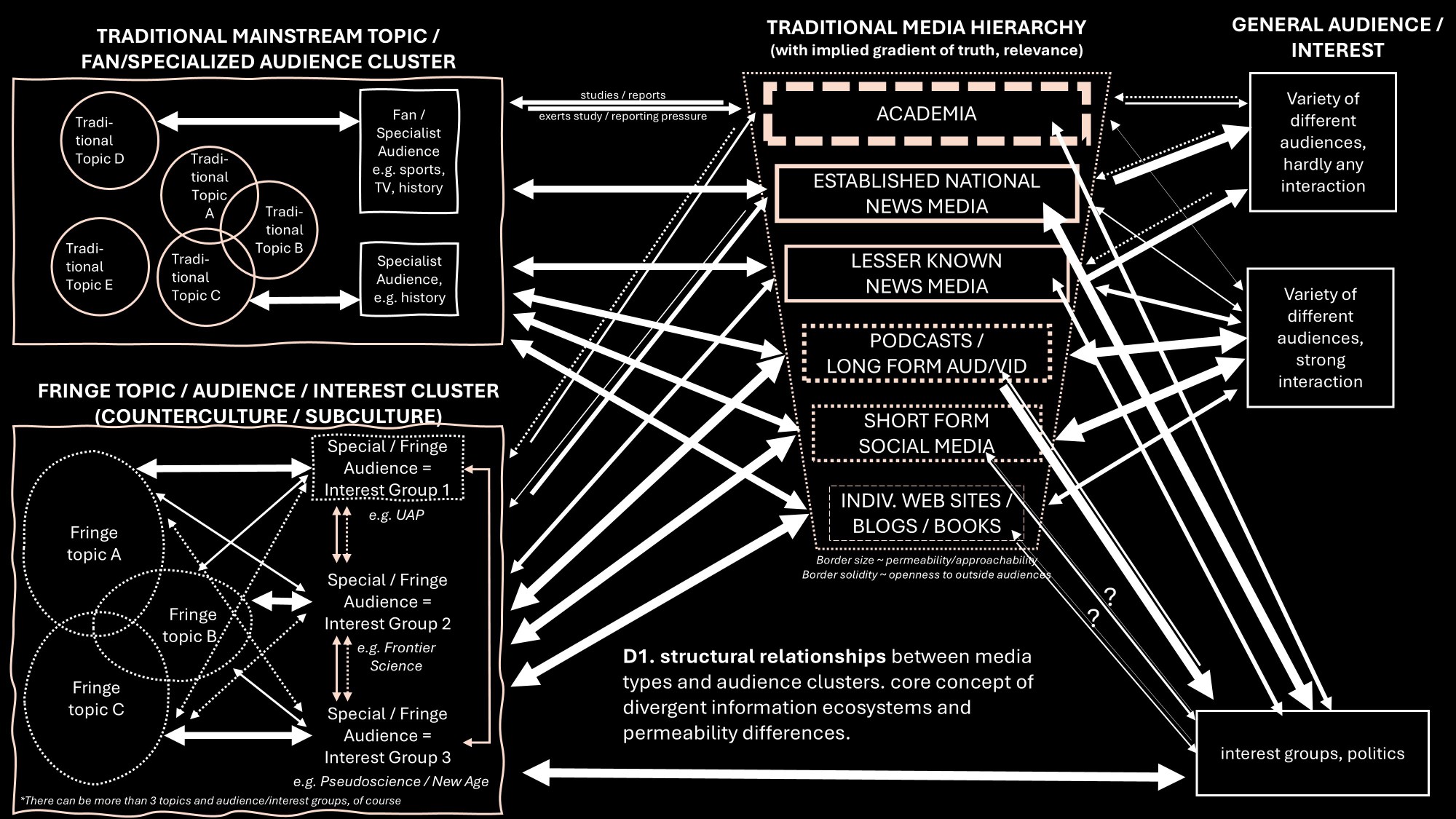
Diagram 2: Showing the flow of information within the previous framework applied to the UAP discourse
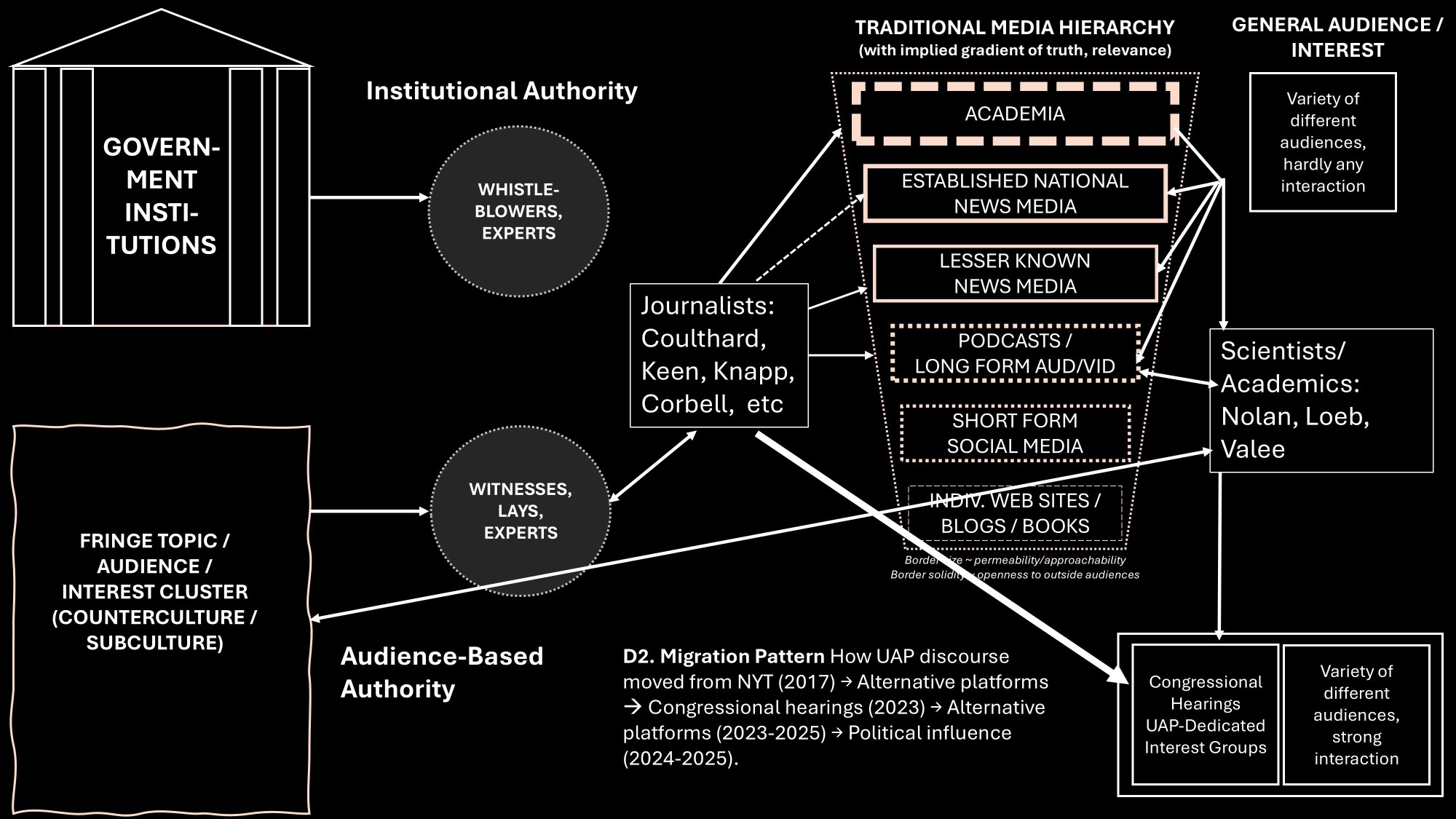
Diagram 3: Comparing Traditional and Digital Media Logic across key dimensions of information production and distribution
| Traditional Media Logic (example: Traditional Public Sphere) | Digital Media Logic (example: Paranormal Public Sphere) |
| Gatekeeping Editorial oversight, fact-checking, source verification Authority Institutional credentials, official positions, peer review Validation Pre-publication verification, multiple source confirmation Audience One-to-many broadcast, passive consumption Timing Publication deadlines, fixed formats Revenue Subscriptions, advertising, institutional support | Algorithms Algorithmic curation, engagement metrics, user reporting Trust Audience trust, viral reach, parasocial relationships Validation Post-publication fact-checking, crowd-sourced verification Networks Many-to-many networks, participatory engagement Real-time Real-time publishing, flexible duration Direct Sponsorships, direct audience funding, platform monetization |

 Erratic Attempts