
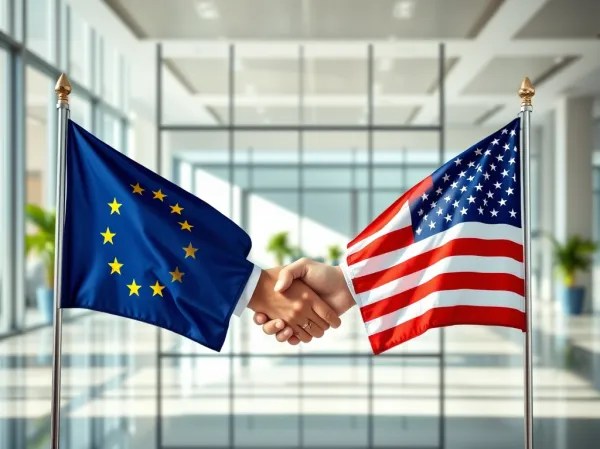
We have seen rather drastic rhetoric from US representatives when it comes to European security. For decades now, the United States have effectively worked as the protector of Europe. They have been the biggest supporter of Ukraine in its defense against an aggressive Russia. Without the American Nuclear Umbrella, without American troops and arms in Europe, the continent would look rather weak.
And now, this is all supposed to change. Is this because of Donald Trump? Does he hate Europe?
Such a perspective is a bit limited. It does not matter whether Trump likes or doesn’t like Europe. The US President is not the president of Europe or the world. This has always been the case. Ideally, American power would help protect democracies globally, and also spread the cause of freedom, democracy, human rights and free market economy globally. This would also increase American soft power. A win-win.
However, we have seen the limits of such a perspective. Without a genuine commitment and partnership in these processes, American help will not achieve what it set out to do. Furthermore, when American (military) power has been used to fight against dictatorships, the results have been mixed if not sometimes catastrophic. Ask Iraq, Afghanistan, Viet Nam and others.
Yet in Europe, the United States have been successful so far. There was also no choice: The US had been drawn in through European misbehavior: World Wars I, II and the Cold War each presented a case for American intervention. There is every chance that Europe, should it destabilize and veer away from its democratic and free market approach, will again prove to be a problem for the entire world. Europe, historically, is the most dangerous continent on Earth, for the entire world.
In a world with a destabilized Europe, autocratic regimes like those of Russia and China would have an easy play. This was the reason for Putin’s attack on Ukraine: Ukraine’s desire to join the European Union was the immediate cause for Russian aggression, especially because Ukraine’s democratic desire was genuine. The EuroMaidan was the fourth attempt to break free from Russia – once early in the 20th century in 1917, with the Ukrainian War of Independence, then after the fall of the USSR, then during the Orange Revolution, and finally, when Russian puppet president Viktor Yanukovich went against the will of the voters and struck down the European path in 2013, followed by the EuroMaidan protests. Supporting Ukraine’s democratic path is worthwhile because Ukraine is genuine in its desire for independence — including the Donbas, Crimea, and other occupied territories, which have voted in free elections to stay with Ukraine (we can ignore the Russian-led fake referenda).
Putin attacked Ukraine precisely because he saw a danger for his own autocratic rule: If a people very similar to Russians can live freely and democratically, then why shouldn’t Russians be allowed to do so? NATO was never a threat to Putin, the European Union was – and is. Europe is Putin’s real target, and he has drawn North Korea, Iran and somehow China into his alliance.
And yet, European leaders act as if none of this is happening. It is them who should have voluntarily increased their military preparedness, cut ties with Russia, sought out how to play a leadership role in cooperation with the United States. Democracy can only succeed if it can stand up to dictatorship, and for that, it needs to be well armed and well prepared.
Europe has gotten used to American protection. It has been Presidents Bush, Obama, Trump, Biden, and now finally again Trump who have pushed for increased military spending – and increased military capacity. This has been consistent US policy. Just because many dislike Trump does not negate the necessity for such a strategy of making Europe stronger.
Now, we have another problem. China appears dead-set to invade Taiwan, an independent democratic country that is not part of mainland China. The free world – a term which is now more important than ever – relies on such attacks to fail. It also relies on Taiwanese technology.
As big and powerful as the United States may be, China poses a real security risk. Europeans keep ignoring the Pacific arena. This has happened before. For most people in Europe, World War II meant Nazi Germany and Hitler. For the United States, it also meant Hirohito, the emperor of Japan, who was allied with Hitler and waged a gruesome war in China and South-East Asia. For his war to succeed, Japan even attacked the United States. A similar scenario may present itself again, this time though with the “People’s Republic” of China as the aggressor.
Without a doubt, the United States needs to be prepared for a possible conflict with China. The better the peace deal for Ukraine will be, the lesser the danger for a war with China. Appeasing Putin though may mean encouraging Xi (while also encouraging Putin to take another bite at Europe).
Europe cannot afford to play second fiddle to US power. It needs to take leadership in its own sphere of influence, and it may even have to help the United States should there be a conflict with China.
Beyond these “known knowns”, there is also the unknown. Who knows what the future still holds. For many months now, there have been strange drone sightings over military bases all over the planet, especially over American sites. We still are not told whose drones they are. A recent case in Germany may well have been due to Russian espionage, but there may well be unknown players out there that have not revealed themselves yet.
As the world is becoming more dangerous, we need to be more prepared. Europe needs to quickly rise to the occasion. This includes Germany. Nobody should be afraid of a heavily armed Germany anymore, on the contrary. Democracy needs to be defended. Without it, there is only darkness.
Is the United States abandoning Europe? No. But it is telling Europe to grow up. Fast.

 Erratic Attempts